
Making the ‘Invisible’ Visible: Indoor Heat, Unpaid Domestic Work, and Women’s Resilience
A Creative Storytelling Project on the Politics of Running a Home in a Warming World
We often imagine extreme heat affecting only workers on the street or at construction sites. But for millions of women engaged in unpaid domestic work, heat is also lived indoors. In poorly ventilated, tin-roofed houses in densely packed neighbourhoods, indoor temperatures frequently exceed those outdoors. Cooking, cleaning, washing clothes, caring for children and the elderly – tasks that are repetitive, time-bound, and physically demanding – become daily sources of physical exhaustion, mental strain, and heightened health risk.
For example, when the kitchen is part of the home itself, the entire space heats up as food gets cooked. To make matters worse, women have to switch off fans to keep flames steady – turning the kitchen, in effect, into an oven. Homes are rarely designed with women’s comfort, safety, or work patterns in mind. Even at night, relief is scarce: while men may step outside or sleep outdoors during extreme heat, many women remain indoors due to safety concerns, privacy, and caregiving responsibilities, enduring high nighttime temperatures with little respite.
Making the ‘Invisible’ Visible: Indoor Heat, Unpaid Domestic Work, and Women’s Resilience is an audio-visual exhibit, co-created by Sonali Verma (SFC) and Pritish Bali (independent artist) that documents how women living in heat-vulnerable settlements experience, negotiate, and endure extreme heat while running households and providing care. It aims to bring indoor heat and its impacts into the public consciousness – shifting heat from being seen as an abstract climate issue or solely an outdoor risk to an everyday, domestic, and deeply gendered reality.
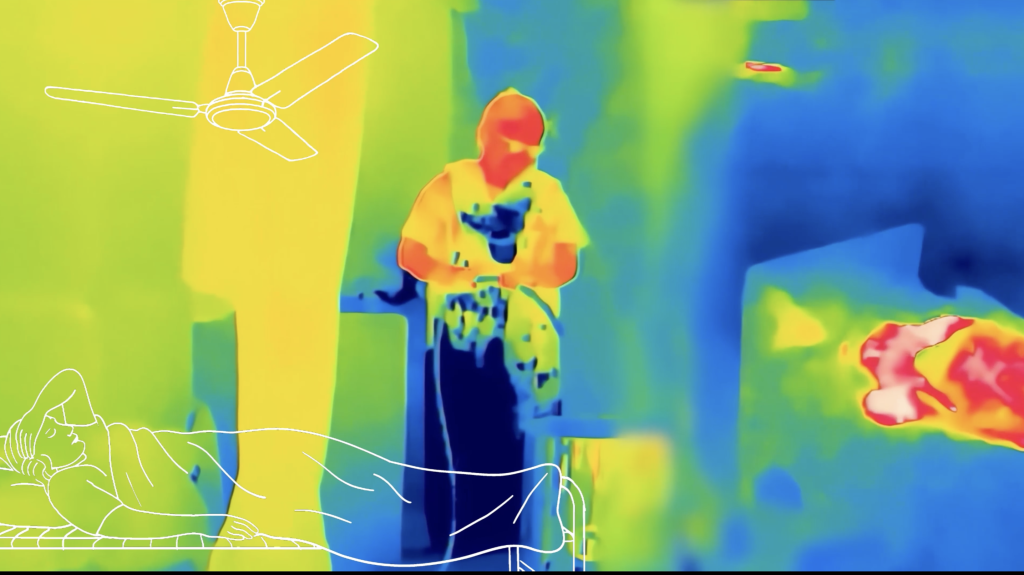
Using thermal imaging footage from homes in low-income neighbourhoods in New Delhi, Mumbai, and Hyderabad, presented on a large video wall as a loop, the exhibit reveals parts of homes and bodies that absorb and hold excessive heat through the day, and the proximity of women’s lives to these spaces. Here is a short snippet.
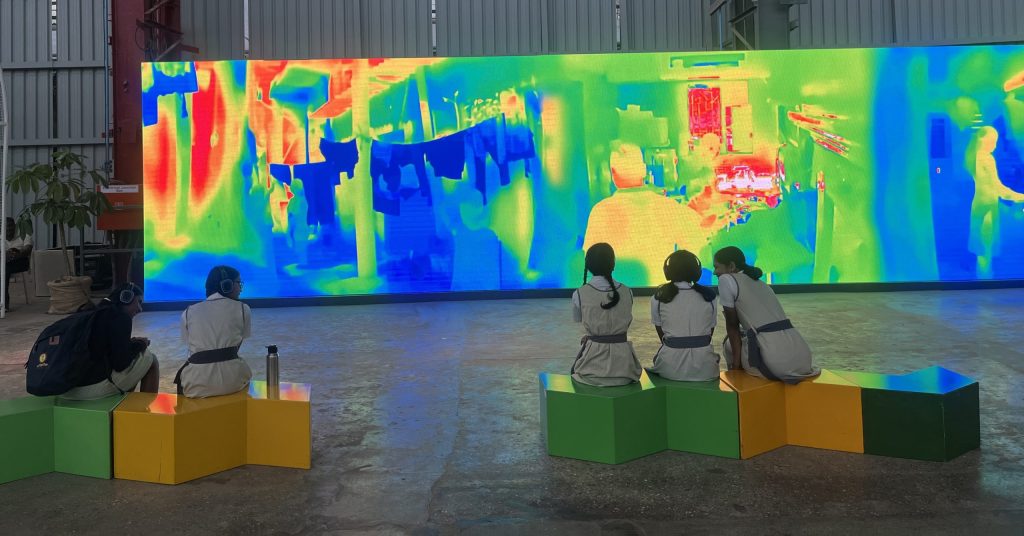
The audio, in a mix of Hindi, English, and Marathi, brings together women’s accounts across ages, geographies, and communities, documenting what it means to work and care for their families in increasingly hot homes. The recordings trace how prolonged heat strains bodies and relationships – from skin rashes caused by damp clothes to feelings of irritability and fatigue after sleepless nights.
Voices from the exhibit
Nasreen Shaikh, who lives with her family of four in a tin-roofed house in Jogeshwari East, Mumbai, describes how extreme heat interrupts her work itself: “Ghar mein pattri ki chhatt ki wajah se itni garmi hoti hai, naak se khoon aane lag jaata hai.” (Because of the tin roof, it gets so hot inside the house that my nose sometimes starts bleeding.)
In a resettlement colony in north-west Delhi, Monika speaks of nights spent awake under the fan: “Garmi ki wajah se raat ko neend nahi aati, aur agle din chidchidaapan rehta hai. Gussa aata hai, aur kabhi-kabhi woh bachchon par nikal jaata hai.” (Because of the heat, I can’t sleep at night, and the next day I feel irritable throughout. I get angry, and sometimes that frustration comes out on my children.)
Women also describe the small, though often inadequate, ways in which they cope. Savita, who lives in a concrete house in New Delhi, explains: “Jab zyaada garmi ho jaati hai toh mein fridge khol kar baith jaati hun thandak ke liye. Husband gussa karte hai ki cooling khatam ho jayegi, par bada fridge hota toh usske andar hi baith jaati.” (When it gets too hot, I sit in front of the open fridge to cool down. My husband scolds me that the cooling will run out, but if the fridge were bigger, I’d sit inside it.)
Collaborators and screenings
The video and audio were developed through collaborations with multiple individuals and organisations. Fieldwork was conducted with the support of Mahila Housing Trust, Nazaria Arts Collective, SEEDS India, and the Urbz Collective.
The exhibit was first displayed at Godrej Design Lab’s Conscious Collective 2025 in Mumbai (11-14 December), which brought together architects, designers, policymakers, researchers, climate practitioners, women homemakers, and children into a shared space. It was also showcased at the Mumbai Climate Week 2026, the India Heat Summit 2026, and the National Gallery of Modern Art, Bengaluru. The work was also presented at the UNESCO Art for Earth: Climate Creativity Lab 2026.
Read: For India’s women, indoor heat is theirs to bear and theirs to fix