
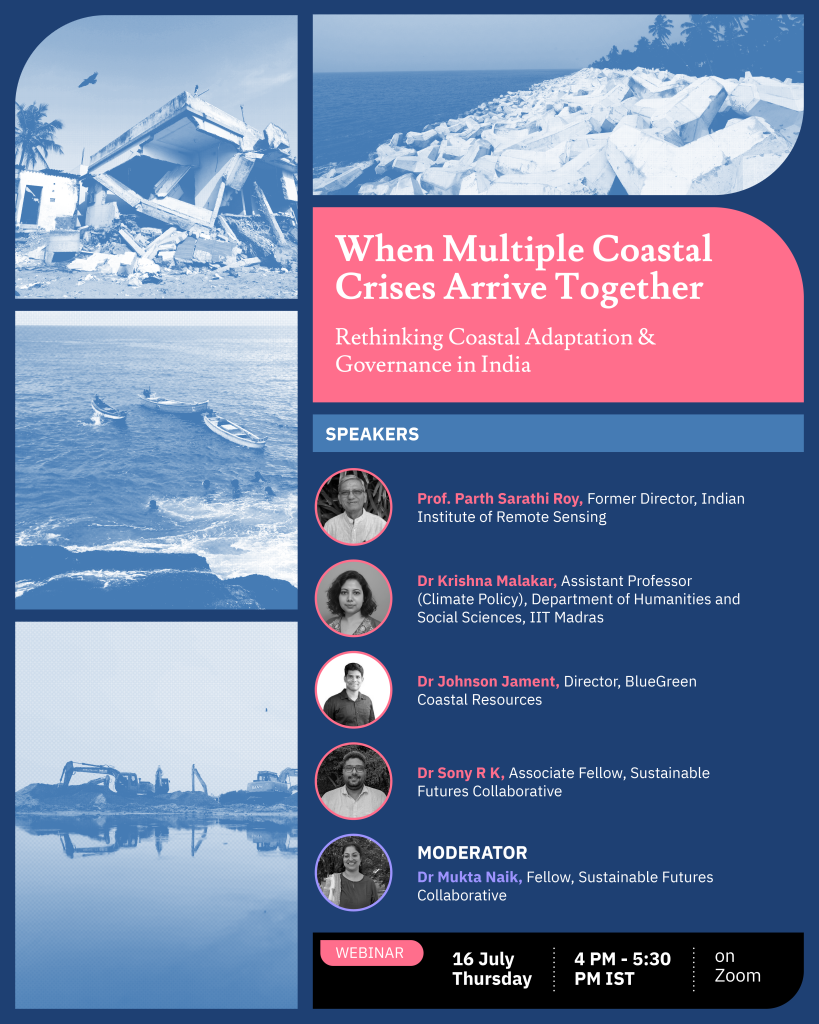
When Multiple Coastal Crises Arrive Together: Rethinking Coastal Adaptation & Governance in India
16 July 2026
4:00 pm
About the event
India’s approximately 11,000 km coastline is a strategic national asset that supports major urban centers, ports, fisheries, tourism, and ecologically important habitats, including mangroves, wetlands, and coral ecosystems. Coastal regions contribute substantially to livelihoods, food security, and economic growth, and are central to India’s blue economy ambitions. Currently, India’s blue economy contributes approximately 4% of national GDP and nearly 95% of the country’s trade by volume is transported through maritime routes.
However, the coastline is exposed to multiple and interacting coastal hazards, including sea-level rise, erosion, cyclones, flooding, and saltwater intrusion, making it highly climate-vulnerable. Rapid urbanisation and competing land-use pressures are additional stressors to these vulnerabilities. While there is a strong recognition that interactions between hazards amplify impact across social and ecological systems, our current responses are often reactive and focused on single-hazard interventions with limited integration across sectors and governance levels. As climate risks and impacts intensify, strengthening coastal resilience is essential for protecting lives and assets, ensuring economic and ecological sustainability, and safeguarding the future of India’s coastal communities.
Strengthening resilience requires moving beyond reactive disaster response toward a long-term, multi-hazard approach to adaptation governance. In practice, a multi-hazard approach involves understanding how different hazards interact and compound risks, integrating risk assessments across coastal, ecological, and socio-economic dimensions, and aligning adaptation planning and decision-making across sectors such as infrastructure, environment, disaster management, and livelihoods. It also calls for encouraging shared use of data, infrastructure, and institutional resources, and combining different types of adaptation responses, including grey infrastructure, nature-based solutions, and community-led interventions, into coherent strategies. A clearer understanding of how we can operationalise such an approach with existing institutions and contexts is critical to shaping resilient coastlines over the coming decades.
This webinar aims to foreground the need for a multi-hazard approach to adaptation and explore the challenges and opportunities in advancing coastal resilience in India.
Speakers
Prof Parth Sarathi Roy, Former Director, Indian Institute of Remote Sensing;
Dr Krishna Malakar, Assistant Professor (Climate Policy), Department of Humanities and Social Sciences, IIT Madras;
Dr Johnson Jament, Director, BlueGreen Coastal Resources;
Dr Sony R K, Associate Fellow, Sustainable Futures Collaborative
Moderator: Dr Mukta Naik, Fellow, Sustainable Futures Collaborative
The discussion will focus on the following broad questions.
- What shifts are required to move from reactive, post-disaster responses to anticipatory and preventive approaches, and how can communities be involved to play a central role in this transition?
- How can planning processes across sectors and levels of government be better coordinated to enable integrated, long-term resilience-building?
- What institutional and data systems, such as geospatial tools and integrated risk assessments, are needed to support a multi-hazard approach to coastal resilience?
Read our issue brief ‘Strengthening Coastal Resilience in India: A Multi-Hazard Approach to Adaptation Governance’