
India’s Second NDC: Revisiting the Intensity of Climate Ambition

India has recently approved its second Nationally Determined Contribution (NDC) to the Paris Agreement, for the period 2031-35. This commitment, despite being announced nearly five months late, serves as an important signal of India’s intent to decarbonise and support global efforts to limit climate change. It also constitutes a critical pillar of the Agreement’s ratchet mechanism, designed to progressively scale up global climate action in a manner that is compatible with the principle of Common but Differentiated Responsibilities and Respective Capacities (CBDR-RC)

India’s original NDC in 2016 had been welcomed as representing significant climate action from a country that accounts for under 4% of historical emissions and whose per capita emissions are still under half the global average. It had three quantified targets and has easily surpassed the first two, enabling it to further tighten its subsequent targets. The original targets and their revisions are shown in Table 1 below.

India’s NDC commitmentsSubmission yearTarget year1. Emissions intensity reductions below 2005 levels2. Non-fossil-based electricity generating capacity shares3. Additional carbon sinks (GtCO2e)
INDC2016203033-35% (surpassed)40% (surpassed)2.5-3.0
Updated NDC2022203045%50%2.5-3.0
Second NDC2026*203547%60%3.5-4.0
Table 1: India’s NDC targets. Source: Authors’ compilation based on India’s NDC commitment announcements.

Of these, the emissions intensity (EI) target is the only economywide measure of climate progress, and it encompasses all other decarbonisation actions, including those relating to its other NDC targets for increasing non-fossil-based electricity capacity and carbon sinks. This EI target is our focus in this article, to better contextualise it and understand the scale of ambition it represents.

Alignment with India’s emissions intensity trajectory

With India’s 2005 emissions estimated to be 1.64 GtCO2e1 and GDP at INR 58.1 trillion2, its 2005 EI was approximately 28.2 grams of CO2 equivalent (gCO2e)/rupee. Using the latest official emissions data from India’s Biennial Update Report to the UNFCCC and GDP data from MOSPI, we calculate India’s actual emissions intensity in 2019 and 2020 (see Figure 1), and observe that emissions intensity had already fallen by nearly 38% below 2005 levels by 2020, ten years ahead of its INDC commitment.
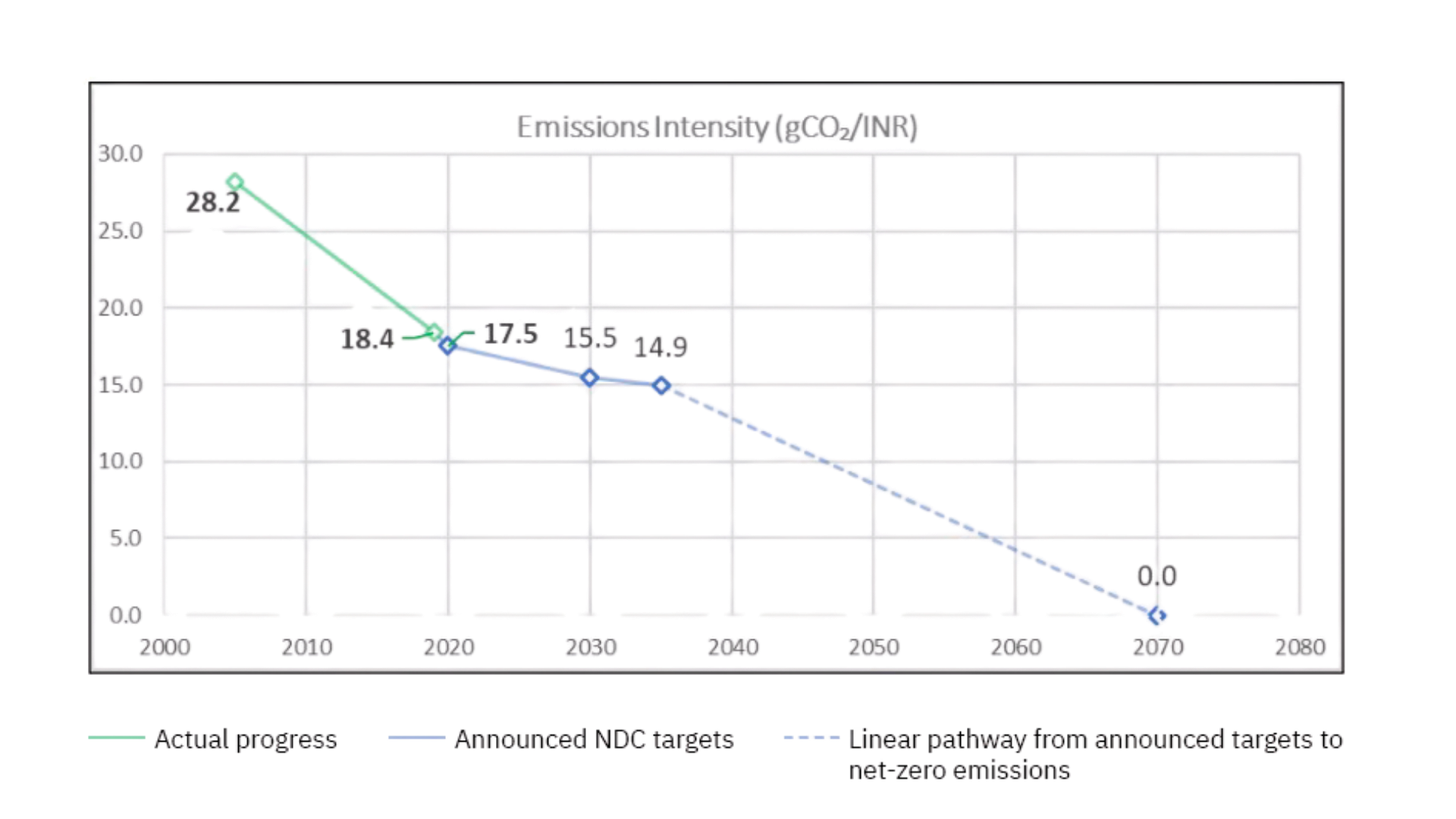
Figure 1: Emissions intensity has steadily declined since 2005 and is projected to continue falling, but reaching net-zero intensity by 2070 requires a sharp acceleration beyond current trends.
Source: Authors’ analysis.

As such, the updated NDC target of 2022 required only an additional 7% reduction in emissions intensity over 10 years, and the second NDC an even more modest 2% reduction over the next five. If India has linearly continued its 2005-2020 rate of EI reductions past 2020 – an admittedly simplistic and challenging assumption – it will already have reached its 47% target by 2024. 

Alignment with Modelled Projections

An assessment of 13 projected scenarios from five emissions-economy modelling studies that have explored India’s growth and emissions pathways3 further contextualises the recent pledge (Figure 2). Five of these projections (represented by the orange bars) can be interpreted as ‘reference’ scenarios, as they represent a continuation of trajectories that incorporate only existing decarbonisation policies and targets as of 2018-2020. The remaining eight are designed to represent scenarios based on additional policies that suggest possible pathways towards full decarbonisation in the second half of the century. The 47% intensity pledge appears to be consistent with – or even less ambitious than – decarbonisation pathways reflected in four of the reference scenarios here.
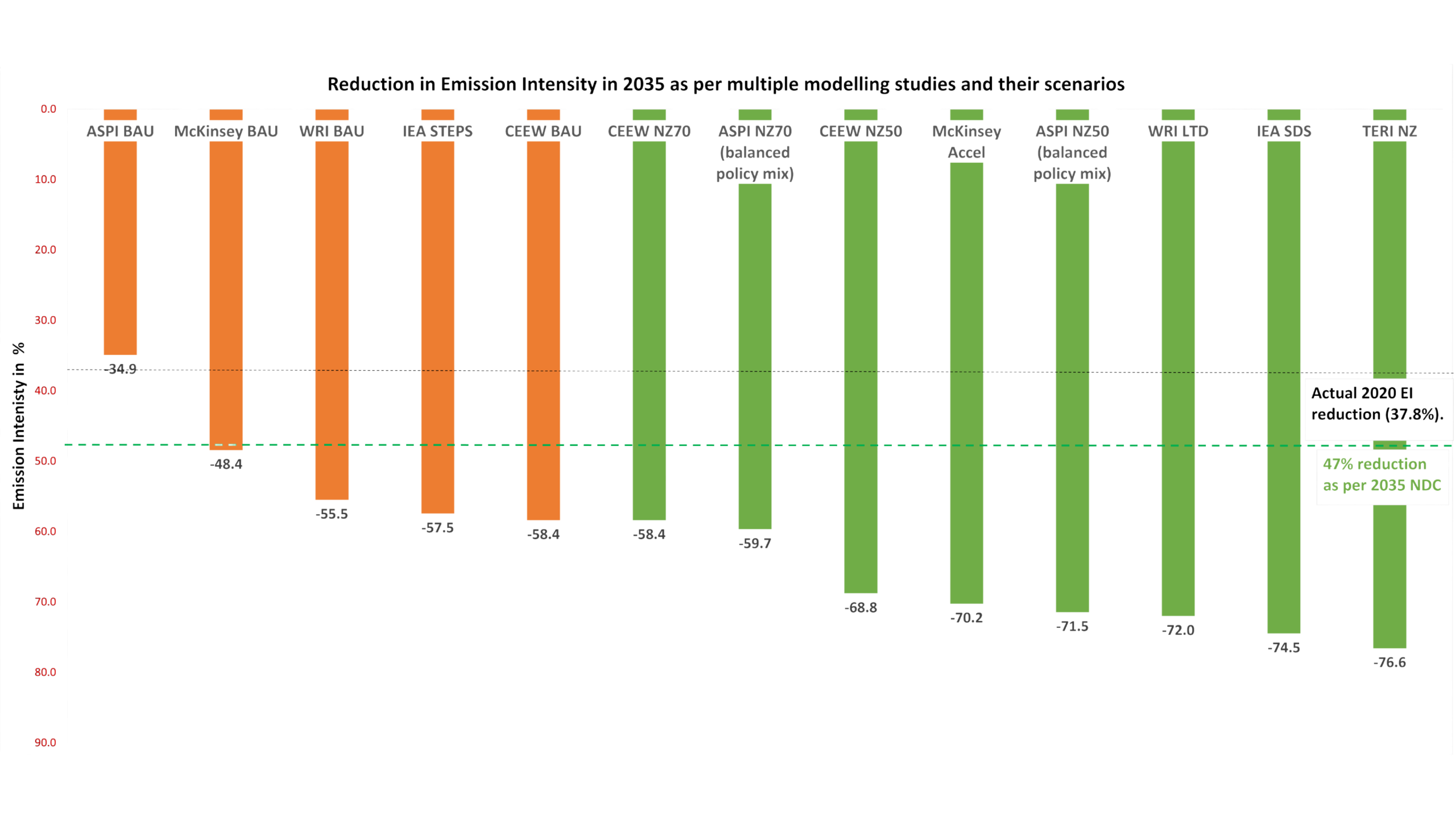
Figure 2: Most modelled decarbonisation pathways exceed India’s 47% intensity-reduction pledge by 2035, indicating that current targets align with, or fall short of, even baseline policy scenarios.
Source: Authors’ analysis.
Notes: (i) TERI-Shell and IEA only model emissions from the energy sector. (ii) IEA provides GDP estimates at 2019 prices; TERI-Shell GDP is based on MoSPI estimates at FY2011-12 prices. (iii) IEA GDP is converted using the exchange rate in its Annex B. (iv) An inflation adjustment is applied from the base year to rescale IEA estimates to FY2011-12 prices, based on a Ministry of Finance Cost Inflation Index.

Impacts on the Carbon Budget

If India were to indeed limit its emissions intensity reductions to 47% by 2035, then – assuming an immediate and linear subsequent decline towards its 2070 net-zero target under constant 5% and 7% GDP growth rates – it would use up between 123 and 158 GtCO2e of the global carbon budget, respectively (Figure 3).
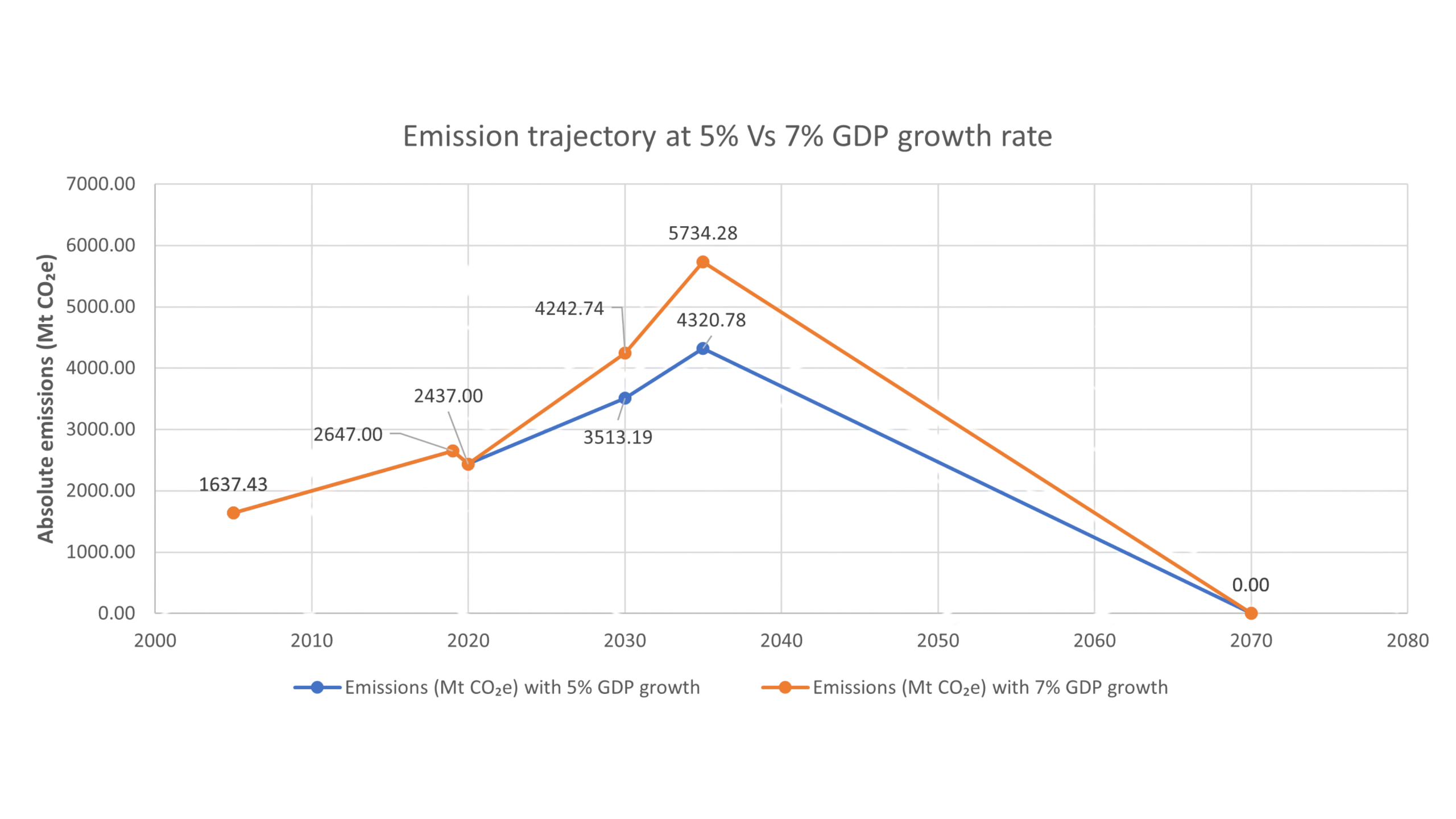
Figure 3: Higher growth raises the peak and delays the decline: emissions under 7% GDP growth peak ~1.4 GtCO₂e above the 5% pathway before both converge to net zero by 2070.
Source: Authors’ analysis.

With a remaining global carbon budget of only 400 GtCO2e as of 2020 to stay within the 1.5°C limit, India could thus exhaust up to 30-40% of this amount alone, with the wiggle room it has created for itself.

Drivers and Implications

While our analysis of the 2022 targets notes that the intensity pledge may serve as an ex-post reflection upon the feasibility of a set of regularly enhanced climate policies, and may represent a conservative underestimate aimed at overachieving its targets, these comparisons suggest that India’s stated climate ambition for the 2030-2035 period is proportionally modest, and is significantly scaled back from earlier efforts. 

This is particularly noteworthy given that India’s emissions grew only 0.7% in 2025, while its GDP growth for the same year was forecast at 7.3%, pointing to a single-year emissions-intensity reduction of 6.6% – meeting nearly the entirety of the distance to the updated 2030 target in a single year alone.

The modest ambition of this target may, in large parts, be a product of the moment. The United States’ withdrawal from the Paris Agreement and receding climate finance commitments from other developed economies have weakened faith in the multilateral climate architecture. Parallel unilateral measures such as the EU’s Carbon Border Adjustment Mechanism – widely viewed in the Global South as protectionist – have further eroded trust in the Global North. In this context, India’s willingness to raise its stated ambition at all is of diplomatic significance, signalling its continued commitment to the Paris framework even in the face of real or perceived inaction by others.

At the same time, it creates more wiggle room for India to scale back its climate actions, and, given its misalignment with India’s own net-zero commitment and its potentially significant impacts on the carbon budget, may be viewed with concern. The argument for more ambitious action has never been stronger. India ranks among the world’s most climate-vulnerable nations, with over 85% of its districts exposed to extreme climate events. Further, in an era of emerging deglobalisation and greater supply chain uncertainties, the strategic case for energy self-sufficiency – enabled by greater domestic clean tech innovation and manufacturing capabilities – has acquired salience that extends beyond climate considerations. 

An emerging vacuum has created an opportunity for India to step more decisively into a leadership role in global climate diplomacy, in a manner that is consistent with its own needs. A more ambitious mid-term signal could have cemented that role; instead, the new target represents a missed strategic opportunity and has opened up space for criticism, not unlike the global response to COP26. 

The key question now is whether stated ambition is at all the driver of climate action, and whether India’s implementation once again significantly outpaces its stated ambition.

Endnotes

  1. Linearly interpolating between the 2000 and 2007 values ↩︎
  2. All GDP values are at 2011-12 prices ↩︎
  3. Each study used different inputs and assumptions relating to data sources, currencies, exchange rates, growth rates, base years, and other parameters. Although we attempted to harmonise estimates to a common baseline, insufficient clarity on modelling processes may limit the direct comparability of these studies. ↩︎
Navigating India’s Climate Futures Requires a Nuanced and Transparent Approach to Modelling

India stands at a critical juncture in its development journey. As the country strives to lift millions out of poverty and achieve sustained, inclusive economic growth, it is also grappling with the urgent challenge of climate change. Balancing these dual priorities requires robust policy frameworks, often informed by emissions-economy models or climate models—analytical tools that can simulate the impacts of economic activities on greenhouse gas emissions. 

However, in rapidly evolving contexts like India, where socio-economic and demographic shifts are ongoing and energy use has historically been low, modelling alone is not sufficient. A more holistic interpretation is necessary — one that considers emerging trends, evolving policy landscapes, and alternative development pathways unique to India’s context.

Recent analysis of India’s energy, economic, and emissions future reveals significant divergences across studies largely due to differences in models and input assumptions. These inputs, such as GDP growth, rate of urbanisation, sectoral energy intensity, economic structure, technology costs, and other factors, underpin how models simulate future scenarios. For example, higher GDP growth assumptions may project increased energy demand and emissions, while lower renewable energy cost assumptions may suggest faster clean energy adoption. Even small changes in assumptions can lead to very different results. This underscores that insights from modelling studies are only as reliable as the methods used to generate them. A more nuanced and transparent approach to modelling is therefore essential—one that allows policymakers to better understand the scope, limitations, and defensibility of study findings.

About ‘The Climate Futures Project’

The Climate Futures Project (TCFP), an initiative of the Sustainable Futures Collaborative, aims to foster the informed use of emissions-economy modelling studies by decision makers, scientists, journalists and concerned citizens. Originally co-developed by the Centre for Policy Research (CPR) and the Indian Institute of Technology (IIT) Delhi, the project applies a common framework to assess, compare, and interpret the assumptions and implications of modelling studies1

Video explainer on The Climate Futures Project by SFC

The framework has two parts to it. The first part provides a structured method to evaluate modelling studies across five key criteria like whether the inputs are credible and transparent; whether the choice of model is appropriate to the objective of the research undertaken; how robustly the scenarios are constructed; if and how the study considers uncertainties; and whether the study outputs are transparent and validated.  Each criterion is assessed through sub-criteria and assigned a score of adequate, partially adequate, or inadequate.

The second part of the framework focuses on interpretation of model outcomes along a set of  parameters. Studies are carefully assessed for what they say/ imply for what socioeconomic development patterns are being locked in, how the energy transition will be managed, what emissions are projected, what the investment needs are, how the study thinks about social equity and natural resource impacts, and what it will imply for India’s energy security. This interpretive lens helps unpack the real-world relevance of technical outputs.

Reasons for divergence in modelling studies

Understanding why modelling studies diverge begins with examining their foundational inputs. A widely cited framework by John P. Weyant, Director of Energy Modeling Forum (EMF) at Stanford University, formerly founded and chaired Integrated Assessment Modeling Consortium (IAMC), outlines five categories of assumptions that influence model outcomes: baseline economic assumptions (reference case), policy design (e.g., carbon taxes vs. mandates), substitution possibilities (adoption of alternatives), technological change (e.g., innovation pace), and benefit inclusion (e.g., health or energy security gains). This framework remains influential because it underscores the need to critically assess model assumptions to ensure robust and well-informed policy decisions.

Research supports this view. Fischer and Morgenstern (2005) and Barker et al. (2006) showed that baseline assumptions alone could lead to emissions forecasts for 2100 varying by a factor of six across models. Even under the same climate policy, models like IGEM and ADAGE yielded different results—with permit price estimates differing by 20% and GDP loss projections varying twofold2. Similarly, global modelling exercises like the MIT Integrated Global System Model (IGSM) demonstrate how varying emissions pathway assumptions can produce temperature outcomes ranging from 0.9°C to 4.0°C. A 2014 study using top energy-environment-economy models to evaluate U.S. emissions reduction pathways found considerable variation in energy strategies, carbon prices, and mitigation costs, largely due to differing technology assumptions. These examples illustrate how model structure and input assumptions fundamentally shape results.

The need for transparency, comprehensiveness, and credibility in models

Such differences highlight the importance of evaluating the five core criteria — inputs, model choice, scenarios, uncertainties, and outputs — for their transparency, comprehensiveness, and credibility.

Transparency is critical to avoid misinterpretation. Without it, models can seem like impenetrable “black boxes,” accessible only to a few experts. As emphasised by the Intergovernmental Panel on Climate Change (IPCC 2022), clearly documenting assumptions, data sources, methodologies, and uncertainties enhances both the credibility and utility of emissions scenarios. It’s not only what’s in the model that matters but what’s left out can be just as influential. Omissions in model design, such as technology options, cost assumptions, or sectoral data, can skew results. Transparency, therefore, is not a technicality but a foundation for trustworthy, policy-relevant modelling.

Comprehensiveness requires that modelling choices and methods are well-articulated. This includes scenario design, data timestamps, and uncertainty ranges. Can another researcher replicate the pathway? Are uncertainty estimates clearly stated? Has the model acknowledged its own limitations? Comprehensiveness ensures that transparency is matched with methodological clarity.

Credibility rests on epistemic validation. Modelling inputs should be based on empirical data, with uncertainties tested against real-world shocks like energy price fluctuations or delayed behavioural shifts. Outputs should be validated through peer review, comparisons with historical data, and cross-model benchmarking. Importantly, studies should acknowledge their limitations—whether related to data, structure, or computational constraints—to properly contextualise findings.

Together, these criteria form a triad of analytical integrity that ensures robustly designed climate policies. By reinforcing the credibility, comprehensiveness, and transparency of modelling studies—and recognising their key role in shaping policy—this approach enhances the utility of future modelling efforts. TCFP seeks to revive a critical dialogue around modelling in India, fostering deeper understanding and informed engagement among stakeholders.

As India advances its low-carbon transition and prepares for the next updates to its Nationally Determined Contributions, prioritising transparent and well-contextualised modelling approaches will be key to designing effective, forward-looking climate strategies.

Endnotes

  1. TCFP has evaluated modelling studies conducted by institutions such as the International Energy Agency (IEA), The Energy and Resources Institute (TERI), the Council on Energy, Environment, and Water (CEEW), and McKinsey & Company, with ongoing assessments of other studies. ↩︎
  2.  IGEM and ADAGE are general equilibrium models that can simulate the effects of a policy on all sectors of the economy. ↩︎