Overview
India’s clean energy ambitions now extend well beyond installing renewable generation capacity towards increasingly making clean energy technologies in India, competitively and at scale. Public research, development, and demonstration (RD&D) builds a country’s knowledge of production processes, materials, systems integration and scale-up, and it is where industrial ambition can translate into domestic capability. This study sets out to answer whether India’s public RD&D is building the knowledge and capabilities its clean energy and industrial ambitions require.
Until now, this system has been hard to see as a whole. Funding is spread across multiple ministries and agencies, with no central register that consolidates them into a view of the public research base. Our report brings together 1,359 publicly funded projects at 90+ institutions, active between 2019 and 2024, representing about INR 1,443 crore (USD 151 million) in declared funding. It covers six areas: renewables, power and storage, hydrogen and fuel cells, transport and e-mobility, energy efficiency, and carbon capture, utilisation and storage.
Concurrently, our new India Clean Energy RD&D Tracker provides a breakdown of publicly available clean energy investments and activities across technologies, institutions, and types of innovation.
We examine how research effort is distributed across technologies, what kinds of innovation the portfolio supports, whether the focus is on products or production processes, and whether all this aligns with India’s broader clean energy, industrial, and climate objectives. The dataset is assembled from publicly available disclosures and should be understood as an evolving resource rather than a complete census of India’s public clean energy RD&D.
What India’s clean energy RD&D portfolio contains
Effort is concentrated, more so by funding than by project count. Among the mapped projects, renewables account for 421 projects and INR 580 crore (USD 61 million), followed by power and storage at 333 projects and INR 492 crore (USD 52 million). Together they absorb about three-quarters of declared spending. Within renewables, solar photovoltaics alone take 234 projects and INR 401 crore (USD 42 million), more than the hydrogen, energy efficiency, transport, and CCUS categories combined.
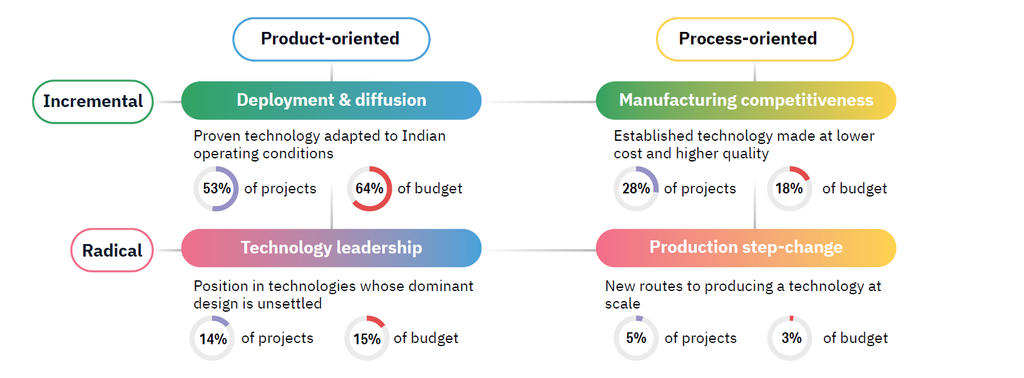
The research is overwhelmingly incremental and product-focused. Across the mapped projects, 81% improve, adapt, or optimise technologies already in commercial use, while 67% focus on products. This pattern is consistent across renewables, storage, and hydrogen.
Funding is fragmented, while projects are small and uniform in scale across technology categories. Across the portfolio, 68% of projects with declared budgets receive less than INR 50 lakh (USD 52,000) and median project size varies only between INR 33 lakh and INR 39 lakh (USD 35,000–41,000) across technology categories, suggesting that different types of research are often supported through similar funding instruments.
Why this matters
India’s transition is occurring under conditions that imported technologies do not automatically accommodate. Research focused on adapting technologies to local conditions can generate real near-term returns. Viewed through that lens, the portfolio is well aligned with India’s deployment needs.
Deployment, however, is no longer India’s only objective. Manufacturing capability has become an explicit national priority. Product innovation determines what is made; process innovation determines how it is produced efficiently, consistently, and at competitive cost. Yet the mapped public RD&D portfolio remains weighted heavily towards product innovation.
The funding architecture reinforces this pattern. Uniform grant sizes may be appropriate for investigator-led research but are less well suited to pilot manufacturing, production engineering, demonstration, and scale-up, where manufacturing capabilities are often developed. Different capability objectives therefore appear to require different funding instruments.
Source: Authors classification and analysis
The central finding is that the balance between deployment, manufacturing capability, and technology leadership appears to have emerged from many independent funding decisions, without an explicit portfolio-level strategy visible in the public record.
What follows
State the intended balance. RD&D strategies should articulate capability objectives alongside technology priorities, making explicit what public investment is expected to contribute to deployment, manufacturing competitiveness, and technology leadership.
Monitor the portfolio, not only the individual project. Portfolio-level monitoring should complement project-level evaluation, allowing policymakers and funders to assess whether aggregate investment remains aligned with evolving national objectives.
Differentiate funding instruments. Different stages of innovation require different scales, time horizons, and institutional arrangements. Broadening the mix of funding instruments is likely to address important gaps more directly than increasing the overall budget alone.
Treat process innovation as a strategic objective in its own right. Work on production methods, manufacturing equipment, quality control, and pilot-scale validation sits closer to industrial production than conventional laboratory research. Supporting these capabilities is likely to require stronger collaboration between public research institutions and industry.