

Environmental Governance and Policy
Air pollution
What Four Years of GRAP Orders Reveal About Delhi-NCR’s Response to Air Pollution: Part 1

17 November 2026
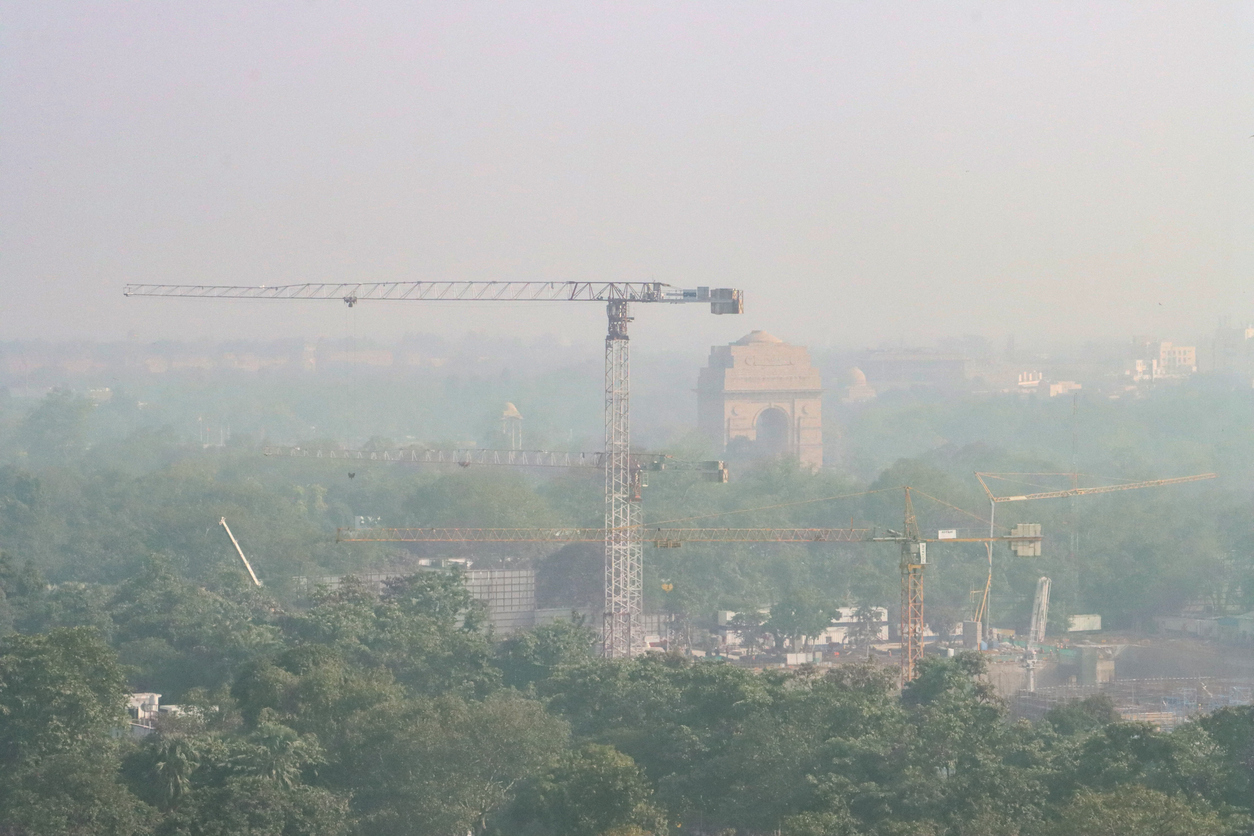
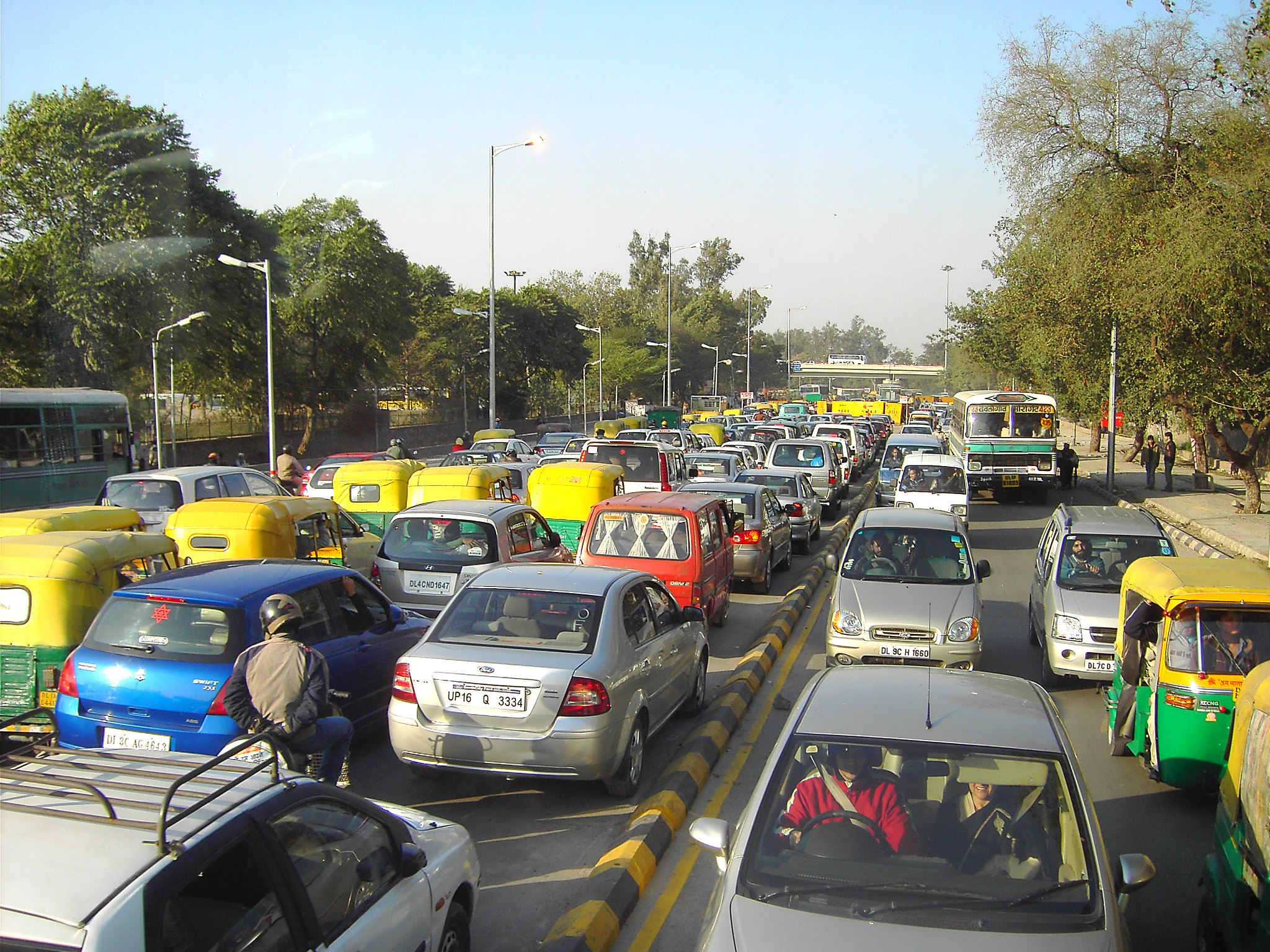
Delhi and its neighbours share one airshed, so pollution in one part of the NCR affects air quality elsewhere. Image: iStock
This is the first in a three-part blog series on the Graded Response Action Plan, Delhi-NCR’s emergency response plan for winter air pollution. By analysing the Commission for Air Quality Management’s orders, schedules, and press releases, we aim to explain when and how GRAP is used, which sectors it targets, and how well it is enforced. We hope readers leave with a better understanding of how GRAP works, where it falls short, and how to make it more effective in tackling Delhi-NCR’s air pollution.
What is GRAP and how is it invoked?
The Graded Response Action Plan (GRAP) is the Delhi-National Capital Region (NCR)’s emergency plan to tackle poor air quality, especially during the winter months. The Ministry of Environment, Forest and Climate Change first notified it in 2017, and the Commission for Air Quality Management (CAQM) now oversees it.
The GRAP’s actions are staggered across four stages, each tied to a band of Delhi’s Air Quality Index (AQI): Stage I at ‘Poor’ (201–300), Stage II at ‘Very Poor’ (301–400), Stage III at ‘Severe’ (401–450), and Stage IV at ‘Severe+’ (above 450). These stages are cumulative, i.e., invoking Stage III means actions to be taken under Stages I and II also apply. However, revoking a higher stage lifts only measures tied to that particular stage; e.g., when Stage III is revoked, Stages I and II stay in force. A sub-committee of the CAQM invokes and revokes these stages through formal orders, based on the prevailing AQI and forecasts from the India Meteorological Department (IMD) and the Indian Institute of Tropical Meteorology (IITM).
Successive stages of the GRAP invoke more stringent policy actions across a plurality of sources that contribute to Delhi’s air pollution, with the most stringent measures (restricting construction and demolition activities, limits on older cars entering Delhi and high-traffic districts in the NCR, and hybrid schooling, etc.) coming in at Stages III and IV given the significant health impacts associated with air pollution levels that high.
The policy actions that comprise each stage are set out in the GRAP schedule, which currently lists 48 separate actions: 25 in Stage I, 8 in Stage II, 10 in Stage III and 5 in Stage IV. The CAQM issues the schedule as a statutory direction under Section 12 of the Commission for Air Quality Management in National Capital Region and Adjoining Areas Act, 2021, and it applies with immediate effect to all designated implementing agencies across the NCR.
The GRAP schedule has been revised six times since August 2022, when the CAQM carried out a comprehensive revision (it came into effect in October 2022), and it was most recently amended on 29 September 2026. Some revisions came before winter; others came mid-season, in December 2024 and November 2025, based on the Supreme Court directions.
In this blog, we analyse all 81 GRAP orders issued across four winter seasons, from October 2022 to November 2026, to examine how the framework has worked in practice. These orders invoked GRAP stages 42 times and revoked them 39 times.
Four stages in name, two patterns in practice
Figure 1 shows how GRAP stages have been invoked and revoked. Instead of four distinct stages, we see two regimes. Stages I and II are in force for extended periods, averaging 169 and 122 days, respectively, between October 2022 and October 2026.
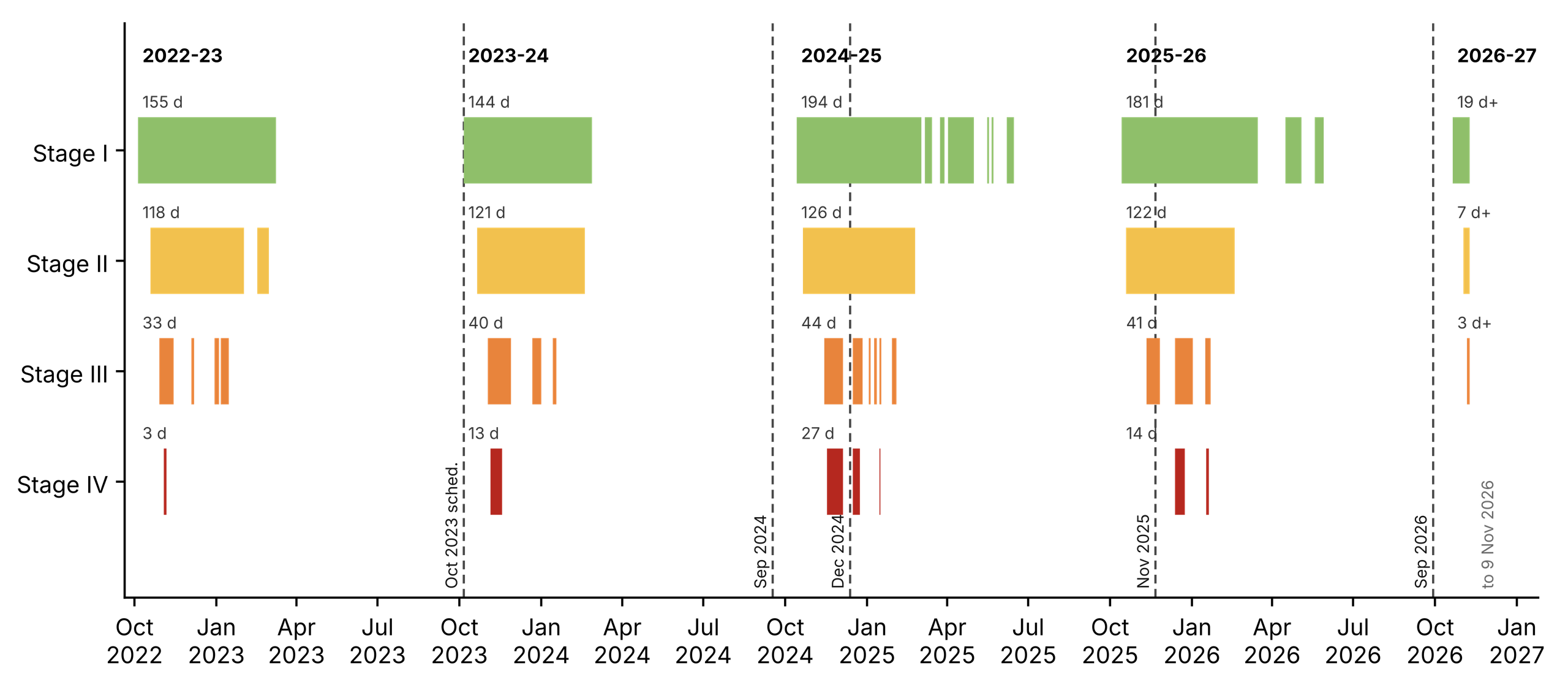
In 2024-2025 and 2025-2026, Stage I was in force for half the year. This means that since 2024, Stage I has extended well beyond winter. Stage II effectively acts as the winter floor, since it is invoked in October, at the start of every winter season. Rather than functioning as emergency measures activated in response to seasonal heat events, they have effectively become the routine, annual baseline for action by implementing agencies.
Stages III and IV, on the other hand, are used as episodic measures. As seen in Figure 1, Stage III was invoked 16 times across four seasons, for 33–44 days, and 7 of those 16 spells lasted five days or less. Stage IV was invoked seven times, peaking in count in 2024-25. Because the stages are cumulative, revoking Stage III or IV returns the region to Stage II. With Stage II as the winter floor, Stages III and IV are invoked or revoked around it, based on AQI peaks and troughs.
A new pattern: GRAP in summer
Since 2025, GRAP has been invoked repeatedly during the summer months, marking a shift from its earlier seasonal pattern.
In 2022–23 and 2023–24, Stage I was revoked by late February or early March and not reactivated until October. In 2025, however, following its revocation on 3 March, Stage I was invoked six more times between March and June, remaining in force for a total of 54 days.
In 2026, it was invoked twice, in April and May, for a cumulative 28 days. While the reasons for this shift are unclear, the extension of GRAP Stage I into the summer months is a welcome development, signalling a move towards more year-round action on air pollution rather than a response confined to the winter season.
When are GRAP stages invoked and revoked?
Since the August 2022 schedule revision, CAQM has stipulated that Stages II to IV should be invoked “at least three days in advance” of the AQI reaching that stage.
The current schedule also states that “actions under Stages I, II, III and IV of the GRAP shall be invoked in advance of the AQI of Delhi reaching to the projected levels of that stage, also provided that the higher projected AQI levels are likely to sustain for longer [sic] period.” In practice, this has happened far less often:
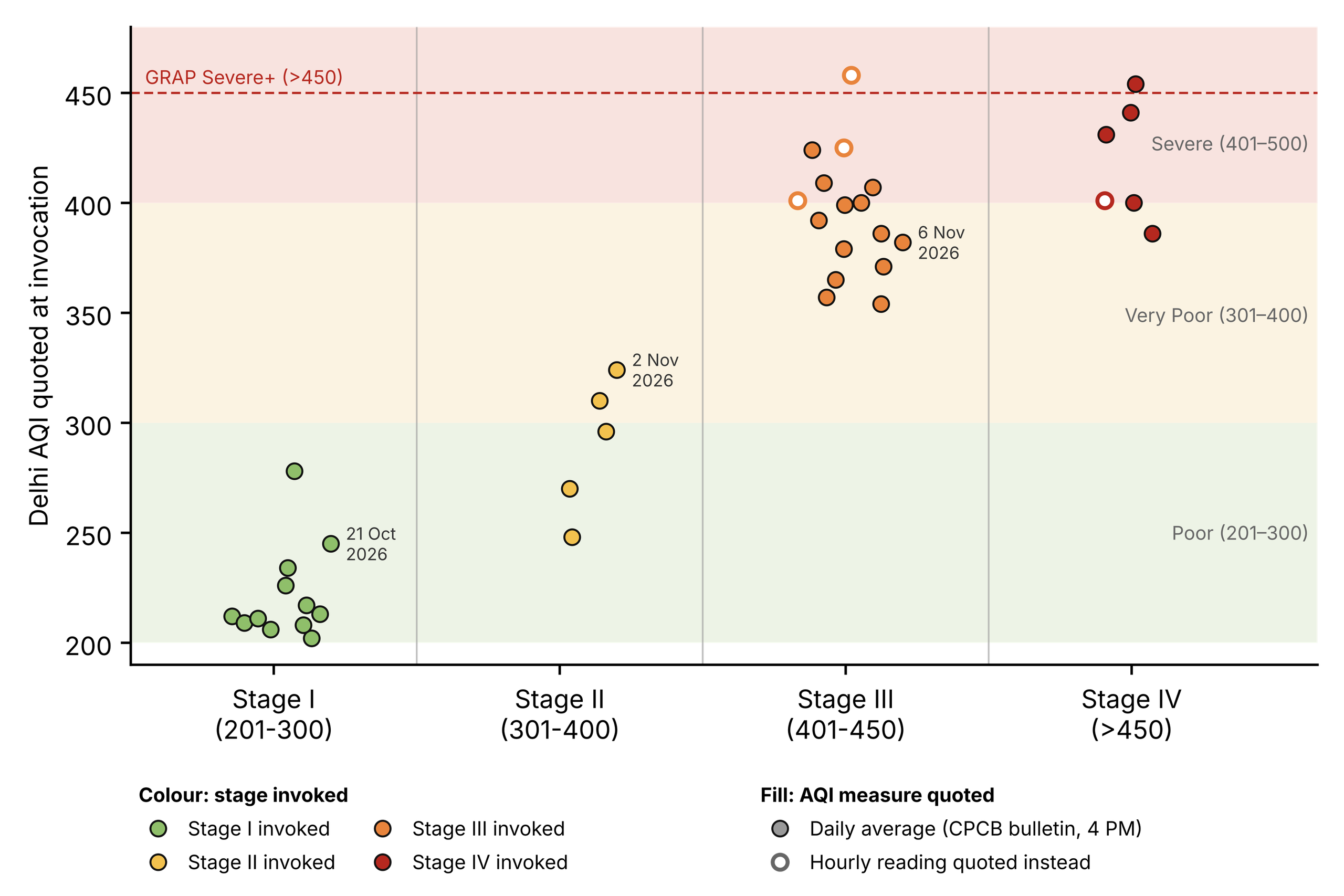
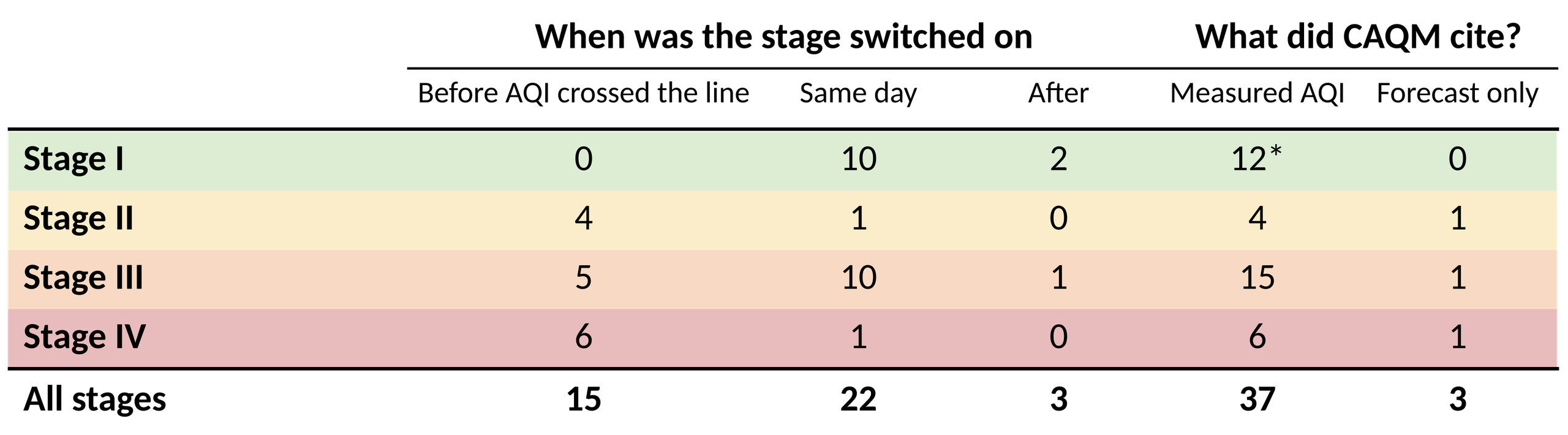
• Most invocations occur on the day the threshold is crossed, or after. Only 15 of the 42 invocations were triggered before the AQI threshold was crossed; 22 came on the same day and 3 after [see Figure 2]. Stage I was never invoked ahead of time. Stage II was triggered before the AQI threshold was crossed in 4 out of 6 instances. Stages III and IV unfold in brief windows, leaving little time to act. So, the timing of the invocations is critical, especially in shorter spells. In Stage III, 10 of 16 invocations came on the day the AQI threshold was breached, and one came after. This is particularly salient because measures become substantially more stringent at this stage. In most instances, Stage IV was invoked ahead of the threshold.
• Lower thresholds do not translate into earlier invocations. Earlier, under the GRAP schedule, Stage III was applied when Delhi’s AQI exceeded 400 and Stage IV when it exceeded 450. In December 2024, the Supreme Court lowered those thresholds to 350 and 400, respectively. After this, every Stage III order came on the day the AQI was crossed, or with a delay. The lower threshold in effect now acts as a buffer. While the CAQM is still acting before the AQI reaches the schedule’s ‘Severe’ band (401+), it is no longer ahead of the new threshold. However, the schedule asks for more: the stages still need to invoke the necessary measures before the AQI reaches the projected levels. Stage IV is the most anticipatory stage, invoked early in 6 of 7 instances [see Figure 2].
• Orders cite forecasts, but largely rely on measured AQI. Almost every order refers to IMD/IITM forecasts, but only in general terms (“likely to remain in ‘Very Poor’ category”). Only three of 42 invocations (all of them in 2022-2023) were triggered on a forecast alone, without a measured AQI value [see Table 1]. The rest waited for the daily 4 pm Central Pollution Control Board bulletin with its 24-hour average AQI figure, by which time air quality had already been bad for much of the day. Moreover, bad air builds up over multiple days in the winter. This is relevant because staying ahead of the buildup in ambient air pollution will help limit how high the AQI rises, instead of simply managing severely polluted air.
• The schedule does not clarify what triggers a revocation. There is no stipulated AQI number or consecutive number of reduced pollution days that leads to a stage ending. Revocation orders cite improving AQI, forecasts and, at times, the “disruptive nature” of restrictions. In 2024-25, the Supreme Court stepped in, keeping Stage IV in force after AQI fell below 450 until it allowed revocation on 5 December.
• Delhi’s AQI numbers, real-time or forecasted, are used to trigger GRAP Stages across the NCR. The case is that Delhi and its neighbours share one airshed, so pollution in one part of the NCR affects air quality elsewhere. The challenge, then, is a lack of precision, as air quality in Delhi may not adequately reflect what happens in other cities in the NCR. An NCR-wide average would better reflect the shared airshed, but it would still be one number for the whole region. Sub-regional or source-based triggers, set for the NCR’s main cities or for specific sectors, would let GRAP act on the places and sources behind each spike. This would require enhanced real-time source monitoring capabilities, but would enable GRAP to address air pollution through source-specific measures across the NCR, rather than invoking the entire suite of measures.
What this means
Poor air quality is generally considered a winter problem for Delhi-NCR, even when its air quality has been documented as poor throughout much of the year. GRAP was initiated as an emergency measure to address worsening air quality, primarily during the winter season. As our analysis shows, GRAP is applied for a large part of the year, including during the summer season. This corrects the misconception of air pollution as a seasonal problem.
Stage I is now in force for about half the year, extending into summer, and Stage II for most of winter, so both work effectively as baselines for annual and seasonal action, respectively. Only Stages III and IV are triggered as an emergency response when pollution levels peak. This raises the question of whether the measures in Stages I and some within Stage II should be part of standalone annual or seasonal action plans rather than a set of emergency measures, and whether GRAP’s stages, as currently drawn, still match its purpose.
In practice, GRAP rarely gets ahead of the peaks. These measures are implemented either on the same day AQI levels breach relevant stage-linked thresholds, or sometimes after, rather than proactively based on forecasts. Delhi’s AQI alone triggers all four stages across the region, with no rules explicitly stating when a stage needs to be revoked. This indicates that the GRAP is enforced less as a plan to stay ahead of pollution and more as a way to manage it once bad air arrives, with an overt focus only on Delhi’s air quality even though the problem is a mix of local and regional sources.
Moving towards a proactive GRAP would mean revisiting its triggers and making forecasts the basis for invocation, not just a reference.
What’s next?
This blog looked at when GRAP is invoked and revoked. The next two look at what it does and how it enforces various actions.
Blog 2 will map each stage’s actions by sector and ask whether they target the main sources and pollutants. It will also trace how the schedule has changed across revisions, and which actions have gained or lost priority.
Blog 3 will cover enforcement, namely, who carries out GRAP’s measures across the NCR, how compliance is tracked, and what happens when agencies or polluters fall short.



Related Publications

Opinions
Environmental Governance and Policy
Post Facto Environmental Clearance: Whose fault Is It Anyway?
Himanshu Pabreja and Neha Miriam Kurian
Live Law | 24 August 2026
The Supreme Court recently ruled that it may grant environmental clearances ex post facto in exceptional cases where violations serve a genuine public interest. While this addresses regularisation schemes, it does not address another question: how did violations of this scale go undetected in the first place?
Opinions
Adaptation and Resilience
Environmental Governance and Policy
India’s heat response is missing public health logic
Purvi Patel
Mongabay India | 27 July 2026
Heat exposure may be shaped by climate, labour, urban planning, and energy systems, but its consequences ultimately manifest in human health. Unless public health outcomes become the organising principle of heat governance, rising temperatures will continue to expose the limits of our response.

Opinions
Environmental Governance and Policy
What needs to be done to make Delhi EV Policy 2.0 a success
Himanshu Pabreja and Bhargav Krishna
15 July 2026
Delhi EV Policy 2.0 is unprecedented in pace and scale for an Indian city. Its goals must be matched by the necessary infrastructure and regulatory clarity.