

Environmental Governance and Policy
Air pollution
How Is GRAP Designed, and How Can It Be Improved? Four Years of GRAP Orders in Delhi-NCR, Part 2

26 November 2026
This is the second in a three-part blog series on the Graded Response Action Plan, Delhi-NCR’s emergency response plan for winter air pollution. By analysing the Commission for Air Quality Management’s orders, schedules, and press releases, we aim to explain when and how GRAP is used, which sectors it targets, and how well it is enforced. We hope readers leave with a better understanding of how GRAP works, where it falls short, and how to make it more effective in tackling Delhi-NCR’s air pollution.
In November 2016, Delhi experienced its highest air pollution levels in 17 years, following which the Supreme Court directed the government to develop a Graded Response Action Plan (GRAP). It was designed as an emergency response plan that would progressively increase restrictions on polluting activities across several sectors as pollution levels rise. Ten years on, the same emergency response plan is invoked for a large part of the year, indicating a concerning normalisation of emergency. While our first blog in this series showed when different GRAP stages are invoked, our second blog asks whether GRAP is designed to effectively reduce air pollution by examining the key sectors it targets, the type of actions being taken, and how it has evolved over the years.
Many actions, unknown solutions
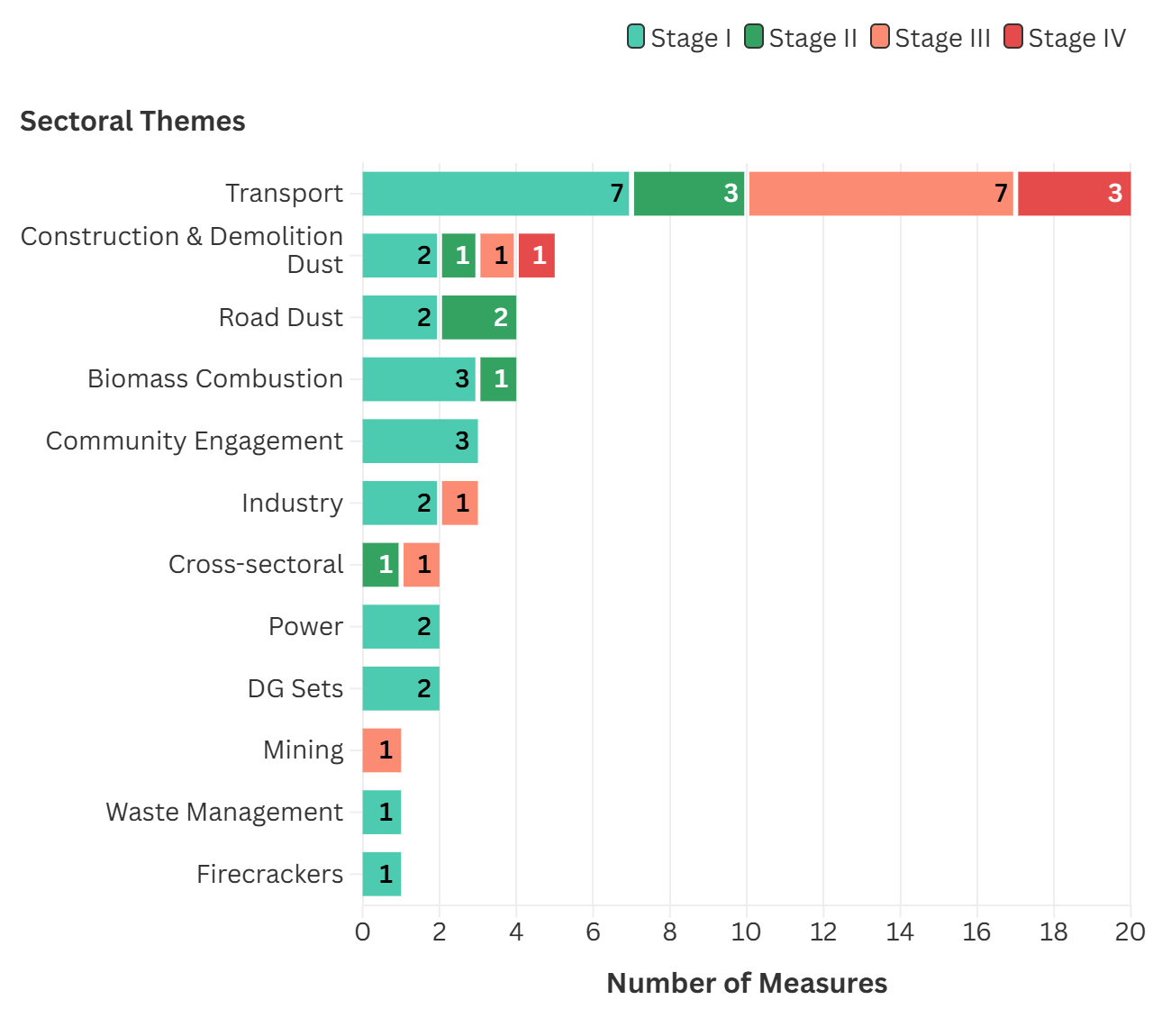
The GRAP schedule lays out various measures to be implemented at each stage of the plan to address air pollution in Delhi-NCR. The measures target multiple sectors, including transport, construction and demolition, power, industry, waste management and biomass combustion, among others (see Figure 1). We describe GRAP measures in some of the key sectors below.
A) Transport
The transport sector has the highest number of measures across all GRAP stages. It involves a variety of interventions starting from controlling vehicular movement (easing traffic congestion, diversion of non-destined trucks and removal of overaged vehicles) and enhanced parking fees in Stages I and II, respectively, to restricting the running of vehicles with older and lenient emission norms (BS-IV and below vehicles) in Stages III and IV (see Figure 2).
Most transport measures are invoked in Stage I, which makes sense given that transport is the largest primary contributor to Delhi-NCR’s winter air pollution and should be tackled early. But their impact in improving air quality will ultimately depend on how well the measures are designed and how effectively the relevant agencies enforce them.
B) Dust
The next largest group of measures targets dust from construction and demolition (C&D) activities and roads, recognising dust as a substantial contributor to air pollution in NCR during winter (see Figure 1).
In Stages I and II, GRAP focuses on water sprinkling on roads and registration and monitoring of C&D sites. C&D activities are restricted across NCR only at Stage III. Still, less polluting/less dust-generating projects, as well as projects such as railways, metro, national security, and linear public projects are allowed to continue. Stage IV prohibits C&D activities for linear public projects, while allowing other above-mentioned projects.
Permitting critical C&D projects to continue may serve public interest, but that must be weighed against the public health harm caused by severe air pollution, to which dust contributes substantially.
C) Cross-sectoral measures
Two cross-sectoral measures under GRAP are noteworthy (see Figure 2). The first is to adopt targeted interventions to abate pollution in identified hotspots. Delhi has identified pollution hotspots and prepared action plans focusing on measures such as traffic management, road cleaning, closure of polluting industries, and waste burning. Following this, other NCR states are also identifying pollution hotspots. GRAP requires interventions at these hotspots from Stage II, but it’s crucial to maintain year-round focus on them, not only after the AQI crosses 300.
Second, states can take discretionary emergency measures under Stage IV (AQI above 450), such as institutional closure, restriction on non-emergency commercial activities, and odd-even vehicle operation. While these wide-ranging powers empower states to take emergency actions within their jurisdiction, it is crucial to recognise Delhi-NCR as one airshed and prioritise measures targeting major pollution sources across NCR.
One schedule for every season
GRAP was initially invoked only in the winter. Since 2024, however, it is now also invoked when air quality deteriorates in summer. Yet the GRAP schedule prescribes the same set of measures for a given AQI range, regardless of season. Air pollution in Delhi-NCR comes from a wide range of sources, and their relative contribution shifts with the seasons. Combustion sources, including transport, biomass burning and industry, contribute more in winter than in summer, while dust is the largest source in summer and declines in winter (see Figure 3).
Rather than introducing a sweeping set of measures targeting the same sources year-round, a more effective approach would be to align measures with real-time source apportionment data to address seasonally dominant sources. This can help lower pollution peaks while utilising limited regulatory enforcement capacity on the sources that matter most in a given season.
Consolidated actions, Supreme Court-led changes
Since the first GRAP schedule was prepared under the directions of a CAQM Expert Group in August 2022, the schedule has been revised six times, with the latest revision in September 2026 (see Figure 4). Despite the CAQM sub-committee being responsible for evaluating experiences from previous years and making changes to the GRAP schedule, many modifications were made pursuant to the Supreme Court directions – a trend highlighting how judicial oversight has shaped the evolution of GRAP.
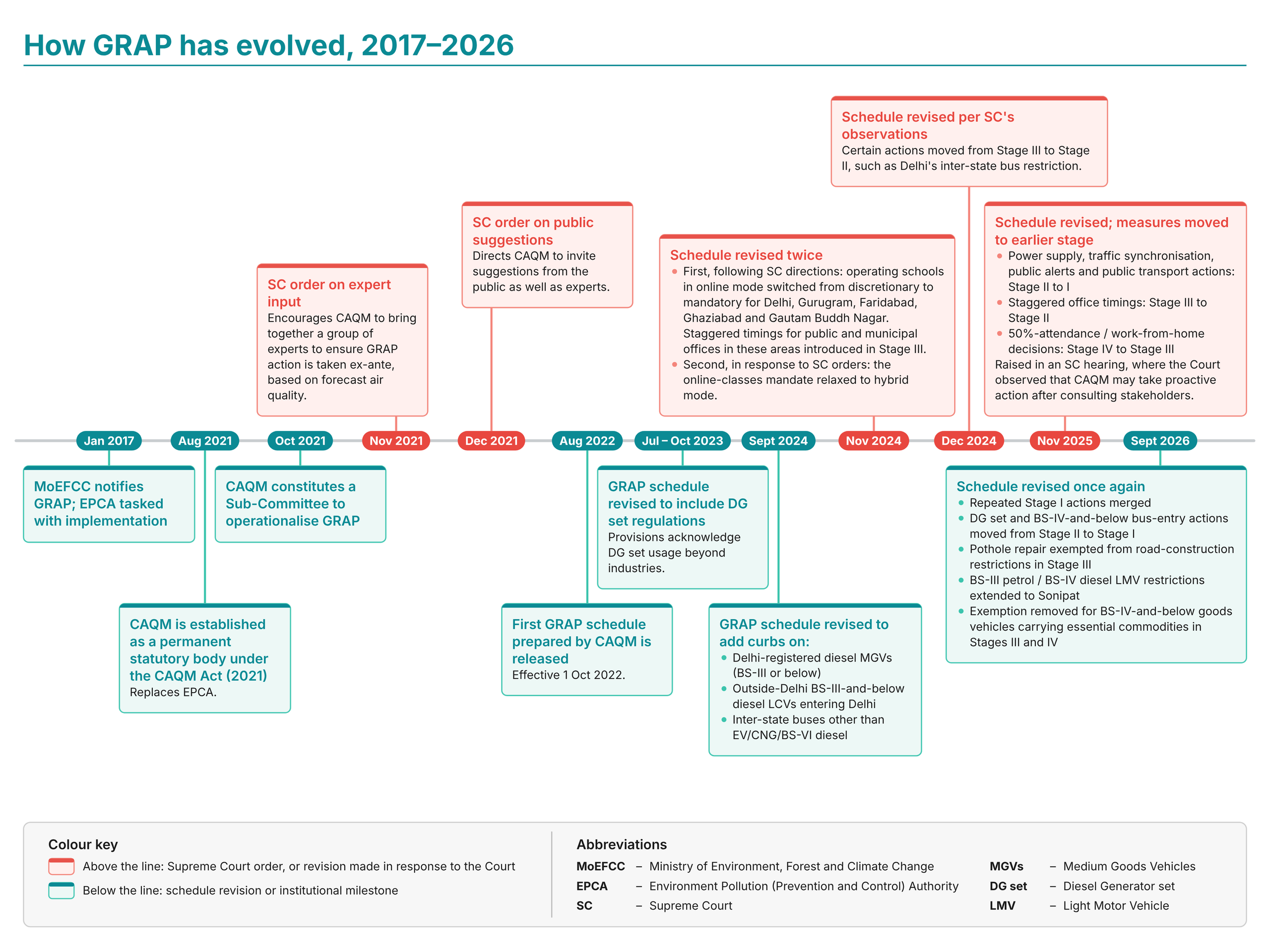
From 2022 to 2026, the total number of actions in the schedule has reduced from 53 to 48. This doesn’t necessarily mean fewer actions, as some have been removed or added, while others have been merged. Actions in most sectors have reduced or stayed the same over time, except in the transport sector where actions have increased.
The distribution of actions across stages has changed marginally, with small increases in the number of actions under Stages I and III and reductions in the number of actions under Stages II and IV. The invocation of Stage I triggers the largest number of actions, underscoring our earlier observation that early efforts to mitigate emissions help prevent increase in pollution concentrations. However, the quality of actions, not their quantity, will paint the true picture of what the invocation of each stage of GRAP means for air pollution mitigation quality.
GRAP’s significant reliance on existing norms compliance and soft measures
GRAP targets various sectors at different stages, but while the number of actions may indicate attention given to different sources, it is crucial to examine the types of measures under GRAP to examine their effectiveness in addressing NCR’s air pollution.
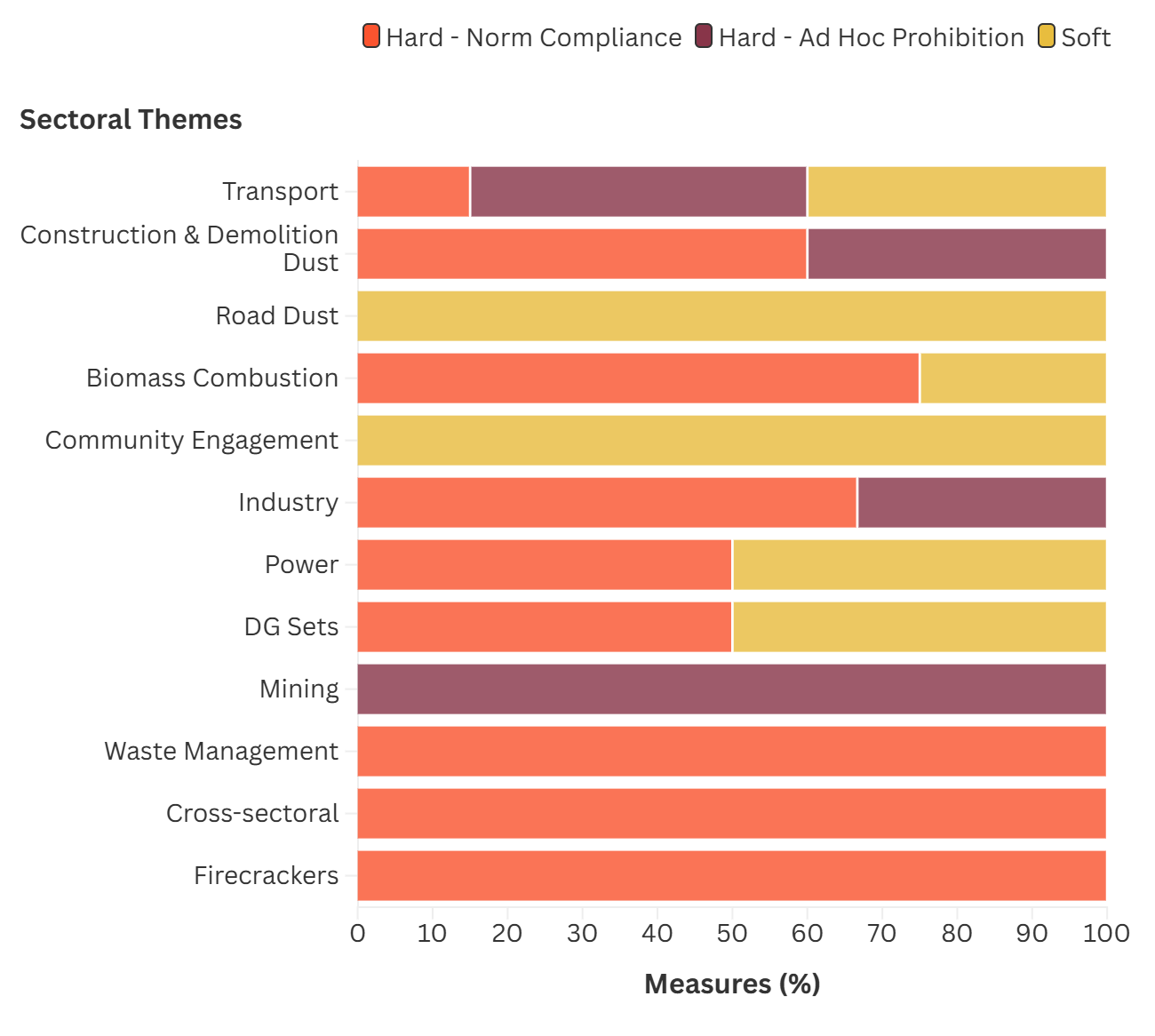
We have categorised GRAP’s measures into ‘hard’ and ‘soft’ measures (see Figure 5):
i. Hard measures aim to abate pollution at the source, and their implementation or outcomes can be measured or monitored. These measures include two types – a) Norms compliance: these actions require agencies to comply with existing regulations (e.g. industrial and thermal power plant emissions norms and waste management rules) or judicial directions (e.g. removal of overage vehicles, firecrackers); b) Ad hoc prohibition: these measures put temporary operative restrictions on certain activities like use of BS-IV and below vehicles, mining or construction and demolition activities.
ii. Soft measures aim to manage pollution or exposure to pollution that is already in the atmosphere. While important, implementation and outcomes of these interventions are complex to monitor or measure. For example, water sprinkling, road sweeping, public transport augmentation, public awareness, and facilitating traffic movement. This category also includes discretionary actions, such as staggered office timings and hybrid working.
Overall, hard measures make up a majority (over 60%) of GRAP, of which norm compliance measures constitute roughly 55%. Soft measures constitute roughly 40% of GRAP.
Delhi-focused measures for an NCR problem
The majority of actions under transport, the dominant sector in GRAP, are either prohibitory or soft (see Figure 5), where initial stages invoke stricter norm compliance and soft measures and prohibitions are triggered only at higher stages. Except for restrictions on the use of polluting buses in Delhi-NCR in Stage I, all other prohibitions apply in Stages III and IV and restrict the use or entry of BS-IV and below diesel vehicles solely in Delhi, not across the entire NCR. This may be too little, too late to control high pollution levels, as polluting vehicles would continue to be used in Delhi until AQI crosses 450, and in adjoining regions even beyond those levels.
Such restrictions focused only on Delhi are also concerning, as they do not treat Delhi-NCR as one airshed where pollutants cross administrative borders and affect air quality across the region. The primary focus on Delhi in GRAP measures also resonates with our observation in the first blog of this series: GRAP is invoked based on Delhi’s air quality alone, creating a response misaligned with the actual levels and sources of pollution in the wider NCR.
Similarly, dust-focused actions initially target road cleaning and compliance with C&D norms, but restrict various C&D activities across NCR only at Stages III and IV, with these restrictions also being subject to several exceptions as mentioned above.
Disproportionate concentration of operational restrictions in higher stages
Overall, GRAP has adopted a combination of hard and soft measures. However, Figure 6 indicates how operational restrictions are concentrated in Stages III and IV, raising several critical questions about GRAP’s design. GRAP was designed as an emergency response plan. Still, by largely repeating existing norms or invoking soft measures, its earlier stages do not introduce additional measures required to manage air pollution as an emergency. This may indicate an underlying assumption by the CAQM that, in the absence of GRAP, pollution control activities are not enforced with complete strictness. This is a concerning aspect that needs to be addressed to ensure year-round air quality action. In our previous blog, we found that GRAP is routinely notified for a large part of the year, even during summer, which signals that it is becoming a floor of action for implementing agencies across the year, rather than a set of emergency measures activated for certain high pollution events.
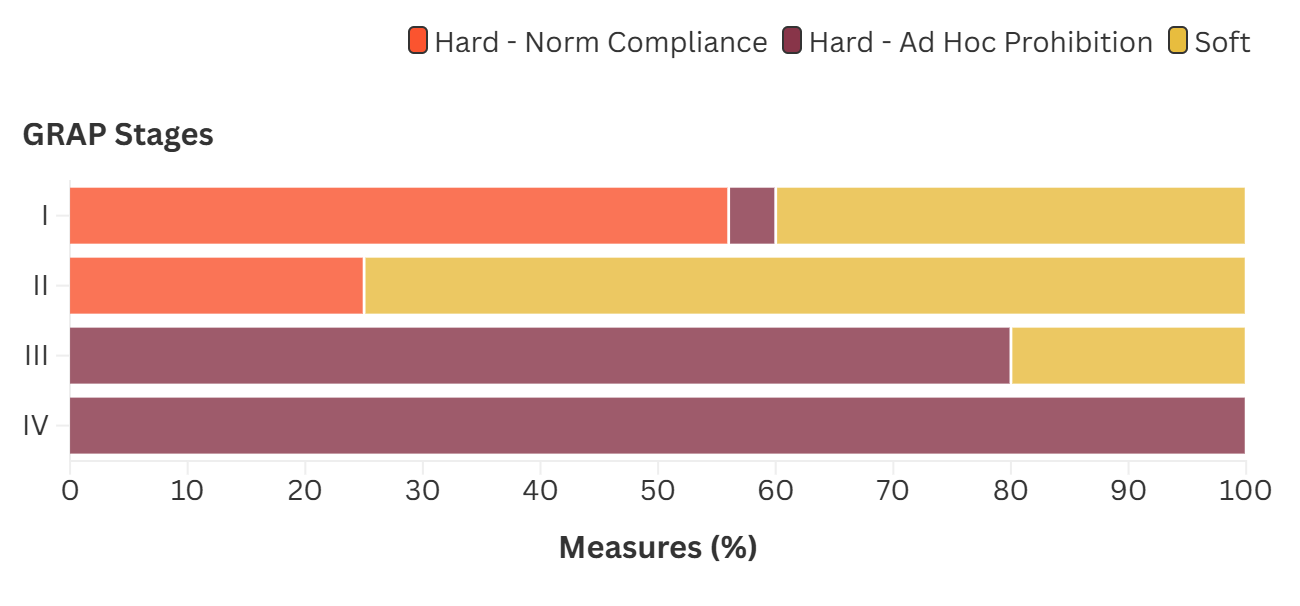
GRAP triggers additional restrictions to control pollution only at higher stages, but that may be too late. Deteriorating air quality already signals inadequacy of existing norms or authorities’ failure in enforcing them, so by largely repeating them, GRAP may, at best, put authorities in air pollution management mode for a few months but would not encourage stronger focus on air quality unless existing air quality norms are strengthened, institutional capability gaps are addressed, and responsible agencies are held accountable.
Back-loading most operational restrictions to later stages may be justifiable to limit public inconvenience. Still, it is misplaced, as clubbing restrictions in the last two stages compounds public inconvenience, since most restrictions would apply at the same time, creating unintended consequences for transportation, the economy, and livelihoods. Allowing activities causing substantial air pollution for a longer period would also allow lock-in of pollutants in the atmosphere and further deterioration of NCR’s air quality – forming a self-reinforcing feedback loop. So, it is critical to revisit GRAP to rationally distribute restrictions across different stages, so that polluting sources can be targeted at the earliest and the invocation of higher stages can be avoided.
What could be the way forward?
This piece examines the sectors targeted and the types of actions in GRAP to assess its effectiveness in addressing air pollution in the NCR. Transport, dust and biomass combustion are the dominant sectors. But GRAP does not provide flexibility in actions and thresholds to account for seasonal variations in pollution sources.
GRAP largely relies on stricter enforcement of existing norms and soft measures, while triggering restrictions on pollution-generating activities only at higher stages. This raises doubts about both its design and effectiveness as an emergency response plan, as the concentration of stricter measures in the last two stages fails to address both public interest and air quality objectives. GRAP needs to be revisited to rationalise these interventions across stages, address major sources earlier, and prevent the health impacts of air pollution. GRAP was intended to address air pollution in Delhi-NCR as an emergency situation; its scope and design should also reflect that objective.
A deeper look at how enforcement of GRAP measures is distributed, planned, and coordinated will explain how the GRAP schedule plays out in reality. The next blog in the series will shed light on the institutions tasked with enforcing and implementing the GRAP schedule and assess whether they are up to the task.
Bhargav Krishna and Arunesh Karkun provided inputs on this blog. Arunesh Karkun helped compile and catalogue the GRAP data underpinning this analysis.
Footnotes
1. “Commission for Air Quality Management in National Capital Region and Adjoining Areas,” n.d. https://caqm.nic.in/landingpage/pages/home; Aditya Dubey (Minor) & Anr. v. Union of India & Ors., WP(C)No.1135/20, 24 November 2021, p. 4; Aditya Dubey (Minor) & Anr. v. Union of India & Ors., WP(C)No.1135/20, 16 December 2021, p. 5.



Related Publications

Opinions
Environmental Governance and Policy
Post Facto Environmental Clearance: Whose fault Is It Anyway?
Himanshu Pabreja and Neha Miriam Kurian
Live Law | 24 August 2026
The Supreme Court recently ruled that it may grant environmental clearances ex post facto in exceptional cases where violations serve a genuine public interest. While this addresses regularisation schemes, it does not address another question: how did violations of this scale go undetected in the first place?
Opinions
Adaptation and Resilience
Environmental Governance and Policy
India’s heat response is missing public health logic
Purvi Patel
Mongabay India | 27 July 2026
Heat exposure may be shaped by climate, labour, urban planning, and energy systems, but its consequences ultimately manifest in human health. Unless public health outcomes become the organising principle of heat governance, rising temperatures will continue to expose the limits of our response.
Opinions
Environmental Governance and Policy
What needs to be done to make Delhi EV Policy 2.0 a success
Himanshu Pabreja and Bhargav Krishna
15 July 2026
Delhi EV Policy 2.0 is unprecedented in pace and scale for an Indian city. Its goals must be matched by the necessary infrastructure and regulatory clarity.