Environmental challenges are an anticipated consequence of development, and India, as a rapidly growing economy, is no exception. An ever-expanding urban sprawl, growing energy needs, and accelerated land-use transformations have caused a range of environmental issues, some visible, and others, more insidious. Driven by these challenges, Indian cities are quickly transforming into hotspots of multiple, overlapping environmental stressors that are fuelling a public health crisis. Many cities are shrouded in layers of toxic haze in winter, and summer days bring with them an energy-sapping heat.
However, conversations around these environmental stressors in India have been unconnected – heat is discussed primarily during the summer, while air pollution gets a focus mostly during the winter – with their interplay largely ignored. While growing evidence has been pointing towards the synergistic effects of exposure to heat and air pollution, the science explaining how heatwaves and air pollution interact – a relationship where one amplifies the impacts of the other – remains largely underexplored. Above all, the link between these two stressors is missing where it matters most: in our policies which are designed largely in silos and are ungrounded in science. As a result of this, public health pays the price.
The State of Extreme Heat and Air Pollution in India – and Current Policies That Tackle Them
In 2024, 95% of the Earth’s surface temperature was significantly warmer than the 1951–1980 average, with nearly one-third of global land areas experiencing the hottest year on record, according to the Global Temperature Distribution 2024. In the same year, India ranked 5th globally for the worst annual average PM2.5 levels, with 13 out of the world’s top 20 polluted cities located in the country. Cities with over a million residents in India are growing fast, and this urban explosion is one of the most visible and irreversible anthropogenic interventions, fundamentally driving socioeconomic changes, and reshaping our relationship with environmental stressors. According to long-term records of the Indian Meteorological Department (IMD), 2024 was the hottest year in India since 1901. Several studies have pointed towards India’s growing concrete jungles and chaotic urban planning as causative factors behind rising temperatures, contributing to around 60% of warming in Indian cities.
Temperatures above 40°C, the threshold for heat waves, are now routinely breached across major urban cities, and the frequency of these very hot days has been rising over the past decade. While 228 cities in India met the National Ambient Air Quality Standards (NAAQS) for daily PM₂.₅ concentrations (60 µg/m³) in 2024, only 33 met the World Health Organisation (WHO) daily safe guideline (15 µg/m³).
In response to deteriorating air quality, the Indian government launched the National Clean Air Programme (NCAP) in 2019, flagging 131 cities (non-attainment and Million Plus) with an initial target to reduce particulate matter concentrations by 20–30% by 2024. However, many of these cities have consistently recorded particulate matter levels beyond the annual average safe limits, and the reduction goal has since been revised to 30-40% by 2026, quietly extending the timeline of the target year.
Meanwhile, Heat Action Plans (HAPs) have been created in several cities to manage the fall-out from extreme heat events.
Both these policies represent important steps in tackling climate and environmental risks in our cities, yet they do not speak to each other or, for that matter, to India’s own vision for how it views the future of urbanisation. Air pollution control and heat adaptation receive passing mentions in flagship urban renewal and development policies such as the Smart Cities Mission and Atal Mission for Rejuvenation and Urban Transformation (AMRUT), leading to the creation of separate systems or programs for each, instead of a coordinated approach — even though these urban challenges are deeply linked.
The Science Behind How Heat and Air Pollution Interact
The interaction of heat and air pollution manifests most directly through warm nights during hot summers, when high night-time temperatures suppress atmospheric mixing and limit the dispersion of locally generated pollutants. With the increasing frequency and intensity of heatwaves, and a lower focus on managing air pollution during summers, it is critical to dive deeper into this relationship to understand how best to develop policies that address both. While the combined impacts of heatwaves and air pollution are beginning to be understood, the way they interact to amplify their individual impacts through atmospheric chemistry pathways is less studied. This largely happens in two interconnected ways:
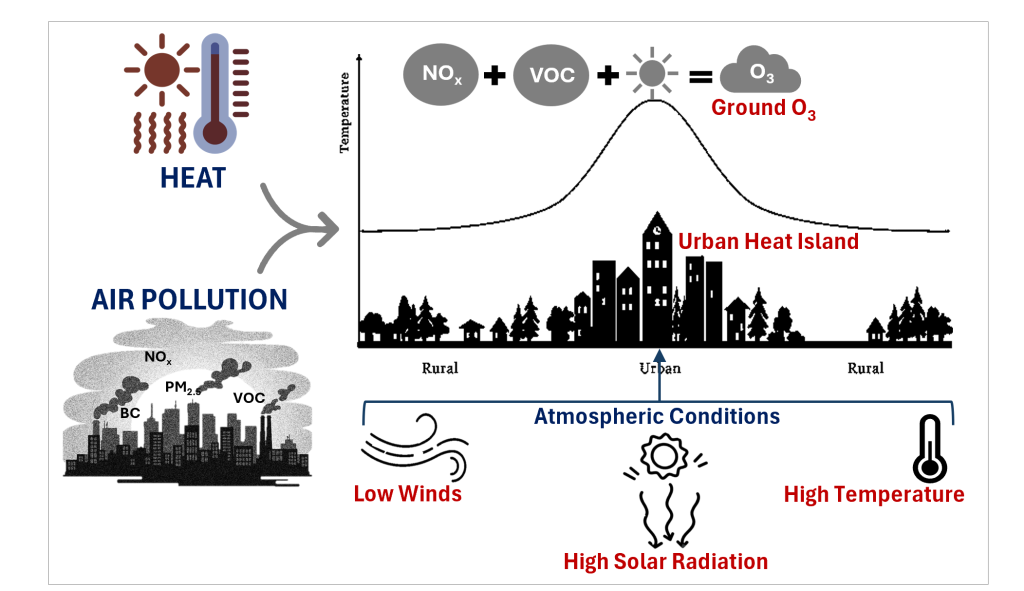
– First, atmospheric conditions with low wind speeds, strong temperature inversions, high surface temperatures, and intense solar radiation worsen particulate matter (PM₂.₅ and PM₁₀) pollution by creating a dome effect that traps the pollutants closer to the surface and reduces vertical mixing of air that aids dispersion. This stagnation reinforces Urban Heat Island (UHI) effects where dense built-up areas and concrete structures absorb and retain heat, slowing night-time cooling.
– Second, high surface temperatures accelerate photochemical reactions involving ozone precursors such as nitrous oxide (NOx) and volatile organic compounds (VOCs), forming ground-level ozone (O3). This interaction adds to the respiratory burden while also intensifying heat stress.
Together, these processes amplify their individual impacts and intensify health risks (figure 1 illustrates this).
At the same time, the seasonal dynamics of heat-air pollution interactions are equally critical and vary across regions and meteorological conditions in India. In inland regions such as Delhi-NCR and the wider Indo-Gangetic Plain (IGP), winters bring anti-cyclonic conditions and a shrinking planetary boundary layer, with low wind speeds and frequent temperature inversions. This prevents upward dispersion, increasing the surface concentration of certain primary pollutants like PM₂.₅ and NO₂, partially independent of photochemistry.
By contrast, during summers, high heat and intense solar radiation accelerate photochemical reactions, driving ground level (tropospheric) O3 formation. Coastal regions like Mumbai benefit from sea breezes that enhance dispersion of PM2.5. However, strong sunlight sustains ground level O₃ in summer, often persisting longer into winter than in inland cities due to maritime influences. Although pollution loads are much higher in winters, the intensity of heat and solar radiation in summers acts as a catalyst, amplifying the effects of air pollution.
Dual Stresses on the Human Body
A study of 10 major Indian cities spanning different agro-climatological zones found that air pollution caused more deaths on hot days, with mortality rising by 0.8% on warm days and by 4.6% on extremely hot days for every 10 μg/m³ increase in PM₂.₅. A review of 40 epidemiological studies found that the combined effects from heat and either O3 or PM can harm both respiratory and cardiovascular health. Heat strains our thermoregulatory system and air pollution inflames our cardio-pulmonary system. They act in tandem, creating a compounding health crisis. Human bodies are sensitive to pollution, and its impact increases when coupled with high temperatures, creating a ‘double stress’ that is extremely hazardous.
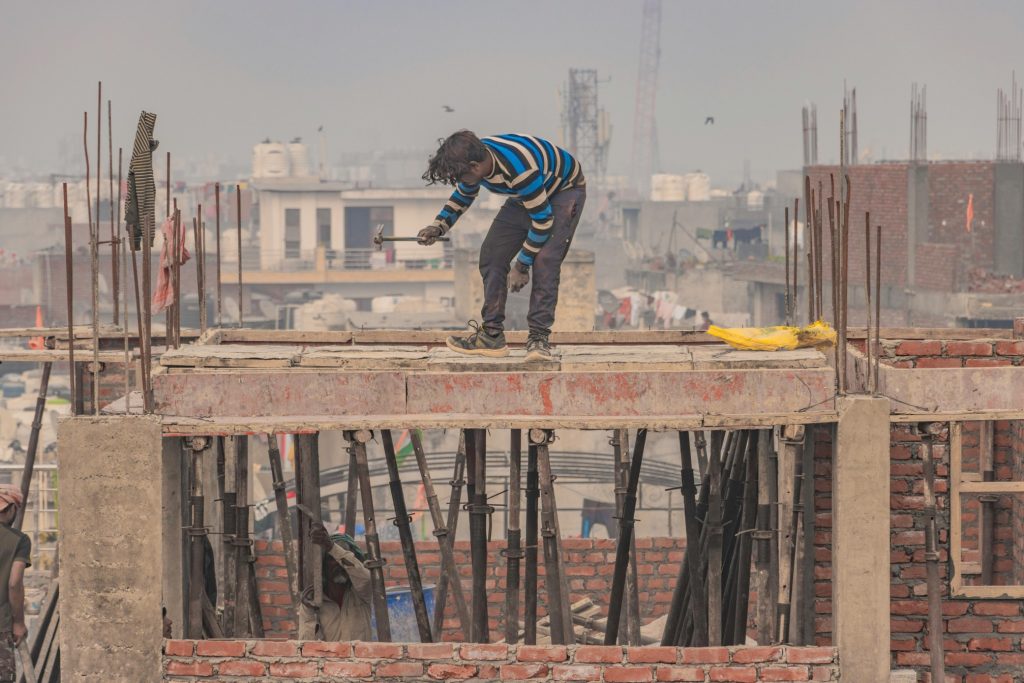
The synergistic impacts are far greater than their individual effects. It would be fair to hypothesise that there is still much to learn about the pathophysiology of heat and air pollution. However, evidence shows that co-exposure to heat and air pollution is linked to higher mortality rates. Together, they induce imbalance in physiological processes, especially amongst vulnerable population groups such as the elderly, those with co-morbidities, and young children. The intersectional nature of their synergistic impacts also becomes apparent when considering that persistent exposure to air pollution contributes to deficient lung function among children, women in low-income households are exposed to higher levels of indoor heat and air pollution, and informal workers, such as those in the construction industry or engaged in gig work, suffer the greatest exposure to extreme heat with limited social protection measures.
Synergistic Impacts, Coordinated Action: Short- and Long-Term Policy Priorities
Heatwaves are now recognised as climate extremes and air pollution as a persistent environmental challenge, but together, they no longer represent a distant risk. Untangling this dual threat requires deeper scientific inquiry into where pollution comes from and why it persists, alongside critical reflection on why policies have struggled to break this cycle.
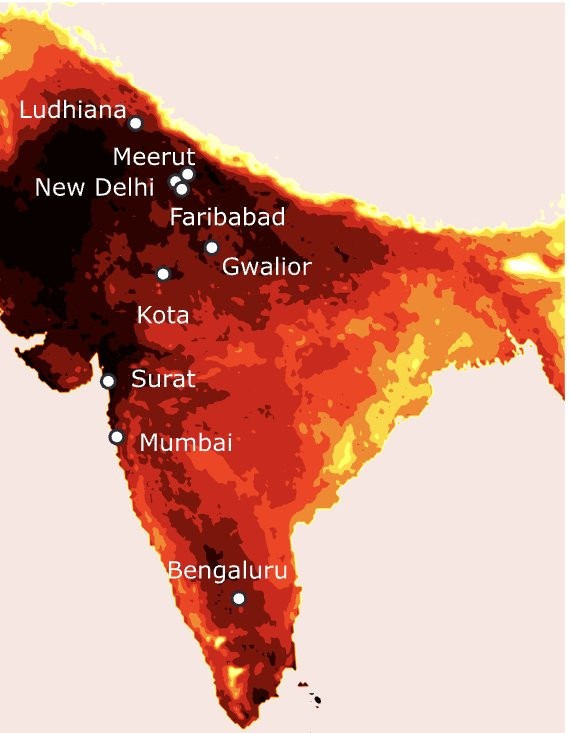
In 2024, New Delhi crossed 40°C as early as April, with temperatures nearing 46°C in June. That same summer, the 20 hottest cities in India – as recorded by the IMD – were concentrated across Haryana, Uttar Pradesh, and Madhya Pradesh. Following IMD’s heatwave alerts, Delhi rolled out its Heat Action Plan (HAP), as did other cities in the region. Simultaneously, air quality in the region hovered around an index value of 225, falling into the ‘poor’ category and triggering the Graded Response Action Plan (GRAP) under the Commission for Air Quality Management (CAQM).
While both the GRAP and HAP were invoked simultaneously, their implementation occurred independently, reflecting the limited cross-sectoral engagement on these dual environmental stressors. This fragmented response also means that there is little scope to address the amplified risk posed by their co-occurrence. Addressing this policy blind spot is critical for a future that embodies convergent action.
From an air pollution perspective, that means year-round action that tackles year-round sources such as transport emissions, and not just seasonal sources such as crop residue burning. A recent national-scale study noted that vehicular transport accounts for a staggering 85% of the VOC emissions and 53% of NOx emissions (O3 precursors). The O3 generated from this vehicular pollution is amplified by extreme heat, and contributes to significant health impacts.
On the heat front, previous studies have highlighted the policy gap with respect to long-term heat resilience in HAPs. Their almost exclusive focus on ameliorating the immediate impacts of heatwaves has meant little attention being paid to addressing the structural issues of crafting heat-resilient cities that reduce the impact of urban heat islands and overall heat exposures.
A long-term view of these issues requires addressing not just the immediate fall-out of high air pollution and extreme heat, but tackling the systemic, structural issues that drive their synergistic threat. The dual burden of heat and air pollution must be tackled in an integrated approach and not as siloed emergencies. Below, is outlined a series of short-, medium-, and long-term actions to guide this effort:
Short-term actions:
– Strengthen early warning systems: Use local data to map compounding risks. Cities should be able to utilise the high resolution spatiotemporal data from local urban sensors to map out the co-risk zones and power real-time dashboards for targeted measures to be deployed more efficiently.
– Enhance public awareness of co-exposure: Craft an awareness campaign that outlines the compounded risk of simultaneous heat and air pollution is imperative. This can be teamed with existing messaging that is put out by respective agencies for public awareness during periods of poor air quality and extreme heat.
Medium-term actions:
– Integration of GRAP and HAP protocols: There is an urgent need to align the GRAP and HAP within a common framework that addresses climate–health risks in a coordinated manner. This integration should be reinforced by linking related efforts such as the National Clean Air Programme and State Action Plans on Air Quality. At the city level, a unified task force could coordinate implementation across sectors, enabling regional impact assessment and enhancing adaptive capacity.
– Combined heat-air quality index: India should pilot a composite indicator that integrates temperature, humidity, and air quality metrics into a unified public health risk scale. Similar tools already exist such as the Monterrey Combined Air-Pollution and Heat Risk Index that combines indices featuring additive and multiplicative formulations to evaluate their combined relationship to mortality. Similarly, the Shandong Air-Health Index combines non-optimal temperatures and the effects of air pollution to assess district-level health risks. These models demonstrate the feasibility of developing similar indices for Indian cities. A combined Heat-Air Quality Index could inform early warning systems, trigger timely emergency health responses, and guide risk communication when thresholds are breached.
Long-term actions:
– Urban greening & cooling infrastructures: Expanding urban greenery can significantly reduce the intensity of urban heat island effects. Global case studies have shown that increasing tree canopy cover by 10% can lower surface temperatures by 0.5–1.5°C in urban areas. By moderating local temperatures, such interventions can also help in reducing peak O₃ formation and manage the experience of extreme heat.
– Thermal comfort through indoor cooling systems: Promoting well-ventilated and centralised indoor cooling systems, combined with energy-efficient technologies that have low global warming potential (GWP), could enhance thermal comfort while reducing greenhouse gas emissions (e.g., CO₂, HFCs) and air pollutants (e.g., NOₓ, SO₂, PM) from power generation.
– Focus on blue-green infrastructure that promotes thermal comfort: Land-use plans that integrate parks, urban forests and water bodies can help cool cities through shading and evapotranspiration, acting as heat sinks. A study in Ahmedabad found that a large park combined with reflective north–south roads reduced local temperatures by 0.17 – 0.33°C. Roads oriented along the north–south axis receive less cumulative solar exposure, absorbing and retaining less heat – a cost-effective strategy to mitigate the urban heat island effect. This, in turn, can indirectly curb ground-level O₃ formation and aid in the limited removal of air pollutants.
– Cross-cutting institutional readiness: Urban planning/city planning departments are a key nodule to systematic redesigning of urban zones. Coordinating with the departments of pollution, health, water, labour, and disaster management collaboratively would be more urban resilient. Training of local authorities and professionals involved in respective departments should be well-equipped with Standard Operating Procedures (SOPs) for timely response.
These recommendations, if implemented in an integrative and sustained manner, can build the momentum needed for collective action towards heat-air pollution challenges.