
Adaptation and Resilience
|9 September 2026
From Fire Suppression to Climate Adaptation: Reimagining Forest Governance in a Warming World
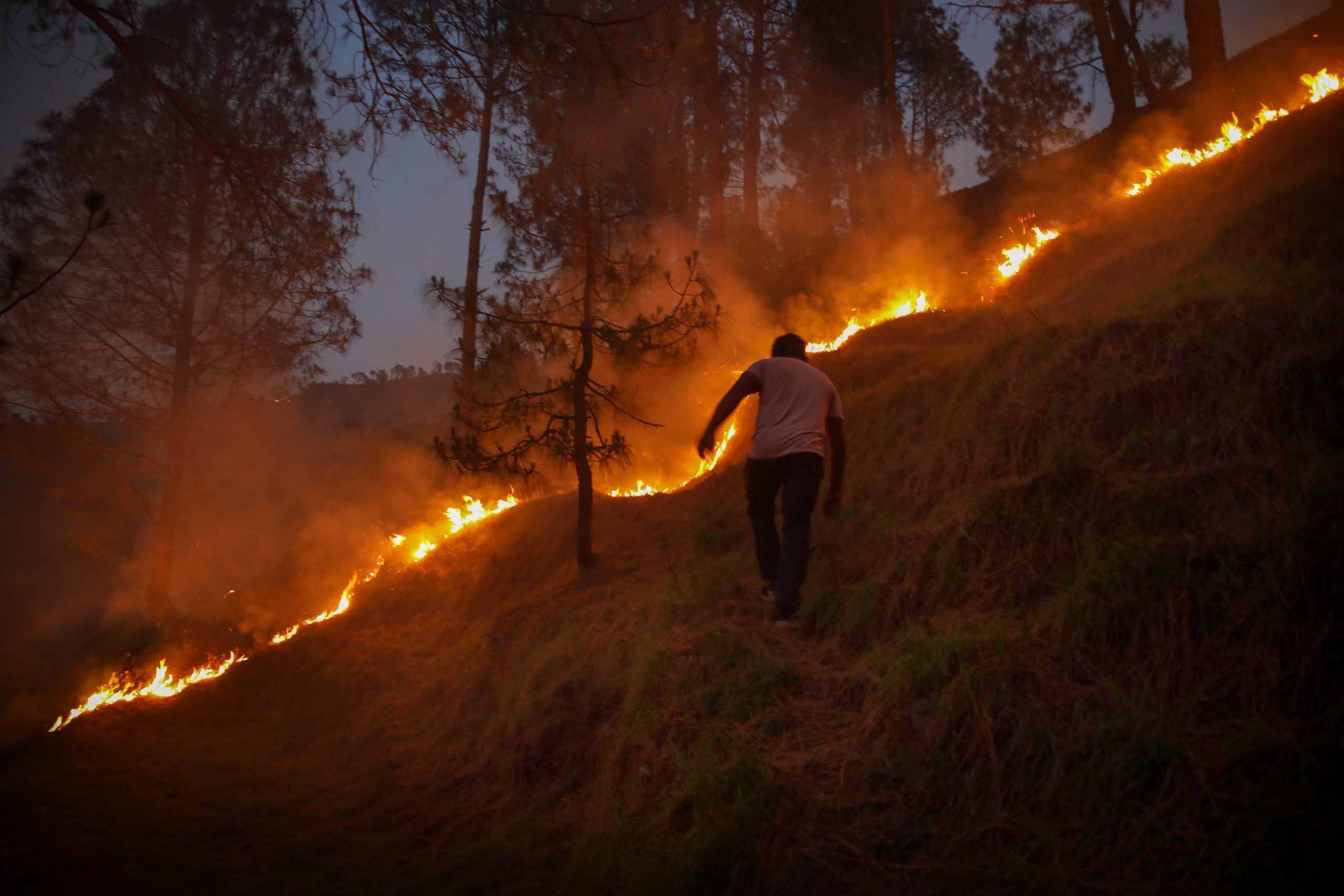
Forest fire event in Uttarakhand. Image: Vikas Choudhary.
Summary
Read the brief
Forests are central to India’s climate and development agenda, underpinning the livelihoods of forest-dependent communities, carbon sequestration, biodiversity conservation, land restoration, and cultural benefits. Yet, they are increasingly vulnerable to climate change, with ~36% of the country’s forests being prone to fire. Moreover, the fire season is projected to lengthen by up to 61 days across India by the end of the century, with nearly 55% of forests expected to experience more severe seasonal fires.
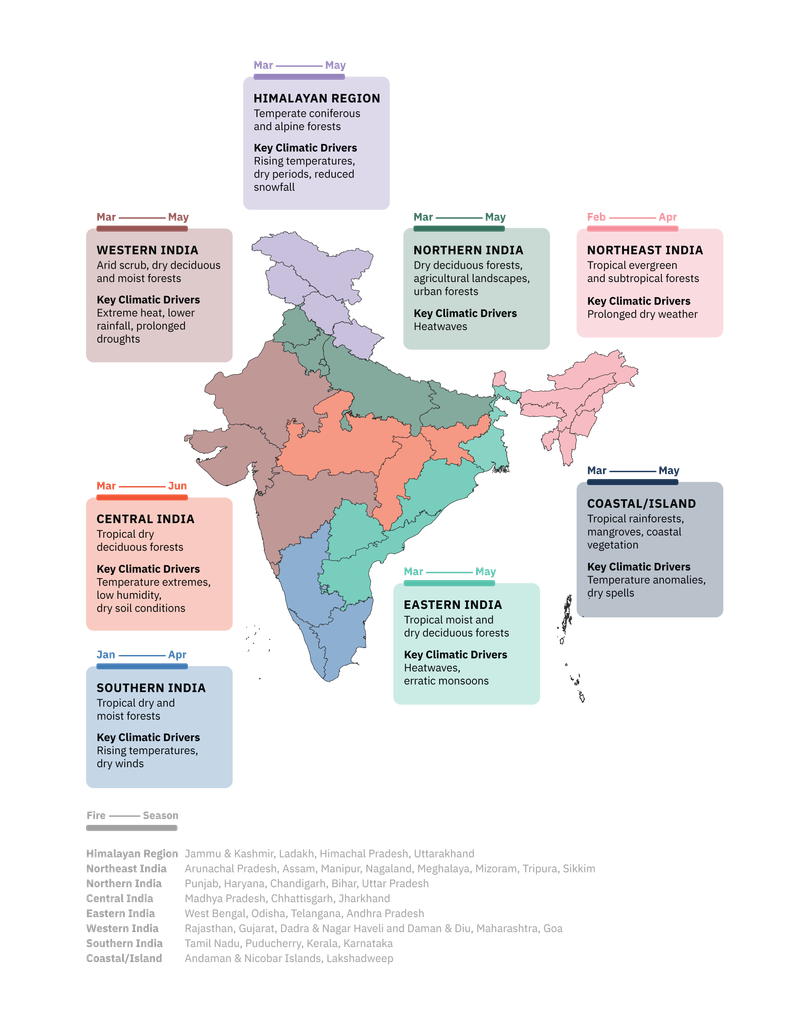
Source: Author’s compilation based on Kumar et al. (2025)
While a growing body of research shows how climate is driving changes in forest fires across India, limited attention has been paid to how governance systems are addressing these changes. To fill this gap, our issue brief uses forest fires as a case to ask two related questions. First, how do current forest fire responses fare in addressing climate-induced changes? Second, which governance frameworks may be better suited to anticipating, responding to, and adapting to forest fires?
To answer these questions, our brief conceptualises forests as Socioecological Systems (SES) where ecological processes, such as those shaping species composition and distribution or disturbance regimes such as fires and droughts, coevolve with social processes including governance, institutions, markets, and communities. We then use the Intergovernmental Panel on Climate Change’s (IPCC) climate risk framework to classify forest fire responses into four types:
– Building adaptive capacity covers responses that enhance the forest system’s ability to anticipate, respond to, and recover from fire risk, such as improving institutional coordination and early warning systems.
– Sensitivity reduction (ecological and social) focuses on lowering the inherent susceptibility of ecosystems and communities to fire through measures such as fire-resilient species mixes, improving forest health, and livelihood diversification.
– Exposure reduction aims to limit how much systems come into contact with fire hazards through measures including fire lines and spatial planning.
– Residual risk management covers response and recovery measures aimed at minimising damage during and after fire events, such as suppression, emergency response, post-fire rehabilitation, and relief mechanisms.
We use the above classification to analyse India’s forest fire policies and their evolution. Our findings show that despite a shift in discourse from a fire-suppression approach to an ecosystem resilience-building approach, forest fire response in India remains dominated by residual risk management through suppression, with funding heavily skewed toward firefighting infrastructure and personnel. Although policies such as the National Action Plan on Forest Fires (NAPFF) introduce fire risk mapping, these assessments do not incorporate climate variables, projections, or scenario-based analysis, and instead rely on static, historical indicators.
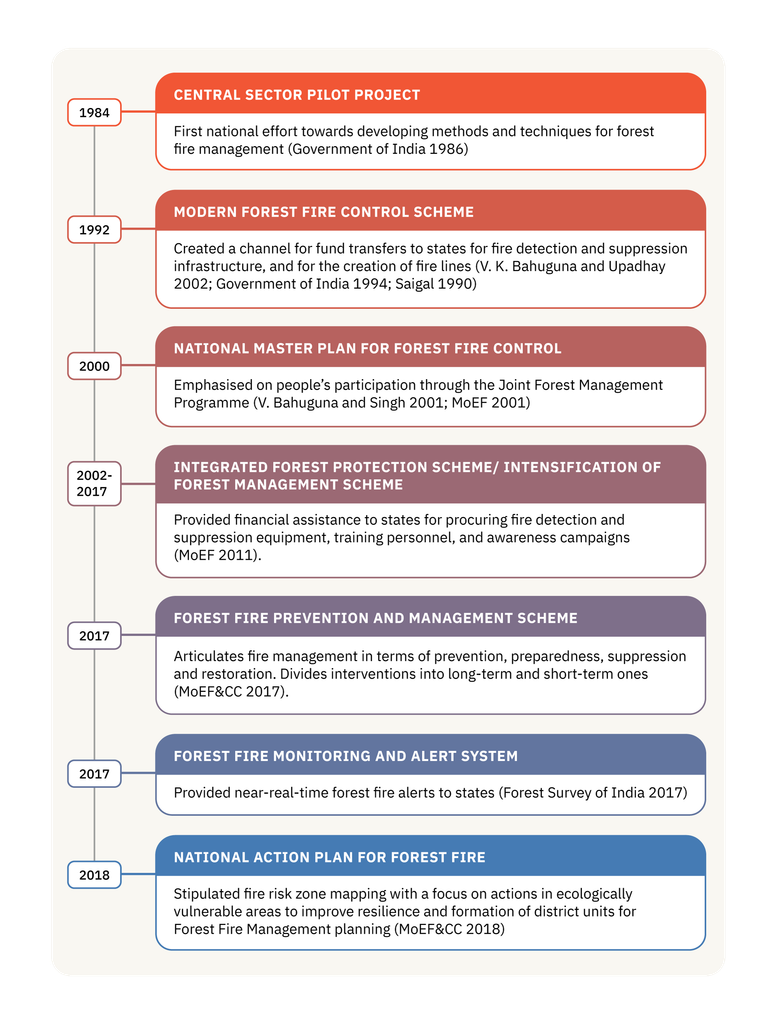
Source: Author’s analysis
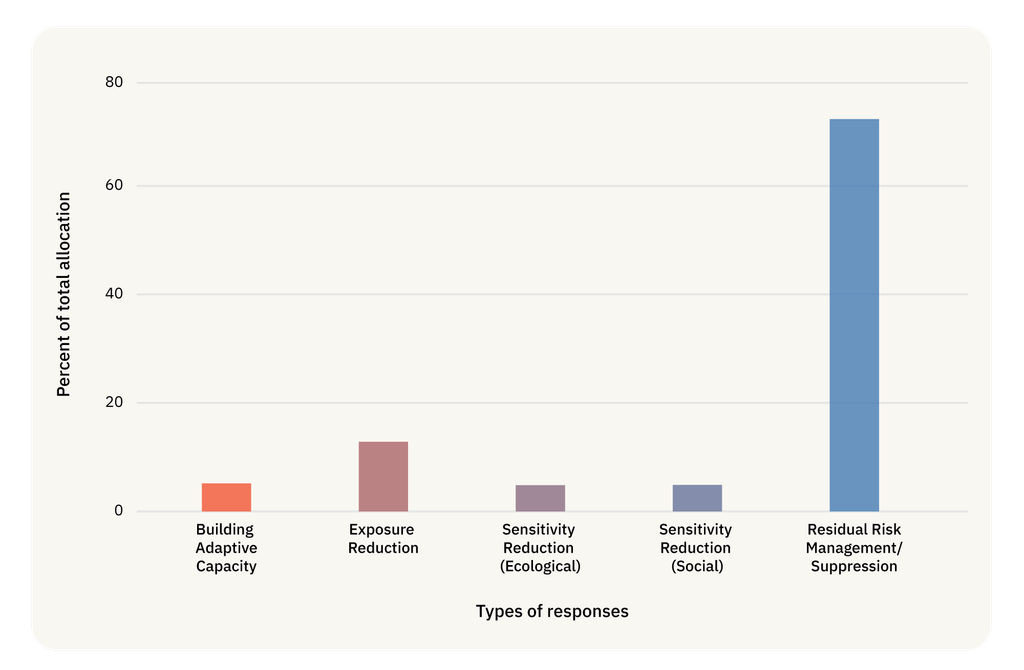
Source: Author’s analysis based on Ministry of Environment, Forest and Climate Change data
Furthermore, we find that community engagement is largely confined to awareness campaigns and firefighting support, with limited attention to fire’s socio-economic impacts. Decision-making remains largely concentrated within forest departments, with limited devolution to local and community institutions. As a result, governance remains administratively decentralised but functionally centralised, and fire continues to be treated as an external threat to be suppressed rather than a climate-driven process co-produced by underlying social and ecological vulnerabilities.
Indian forest fire governance’s focus on suppression, along with limited climate information, fragmented institutions, and limited community engagement, creates a structural mismatch in the face of emerging climate risks. Addressing this requires a shift towards adaptive governance that integrates climate risk, strengthens socioecological understanding, and enables flexible, learning-based, and multi-level decision-making systems.
While recent forest policy articulation has begun to recognise resilience and risk, this intent is not consistently translated into planning, financing, or implementation. Addressing forest fire risk under climate change requires moving beyond residual risk management towards a more balanced approach that also reduces exposure and vulnerability. This presents a critical opportunity to reimagine 21st-century forest governance that sustains the ecological, economic, and social functions which forests support in a warming world.