
Climate Policy
|11 August 2026
India’s Electric Vehicle Ecosystem: Stuttering Transition or Strategic Reorientation?
Introduction
Read the brief
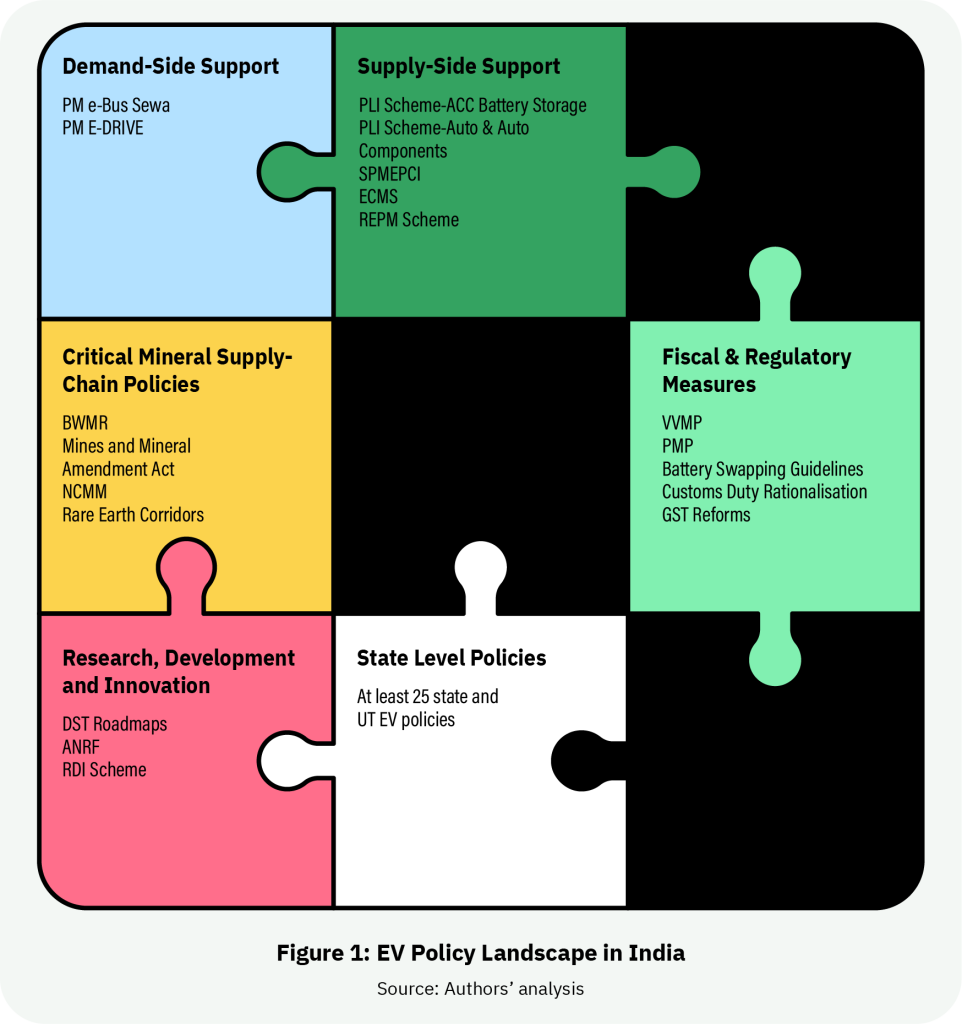
The shift to EVs is happening worldwide; about one in four cars sold in 2025 was electric (International Energy Agency 2026). Over the last decade, India has begun a serious push toward electric vehicles (EVs). The Government of India and most state governments have implemented a range of demand and supply-side support policies (Government of India, n.d.-c, n.d.-d), and the early momentum has come from below. Start-ups and established automakers have begun to make real gains, primarily driven by the rapid adoption of electric two- and three-wheelers (e2W and e3W) (Government of India, n.d.-b; EVreporter.com 2026).
In parallel, public charging has begun to expand in major cities and along key highways (Government of India, n.d.-a) and domestically assembled models are now on sale across a range of prices.
The numbers capture how quickly this has moved: between FY 2019-20 and FY 2024-25, annual EV registrations rose from 1.74 lakh to 19.68 lakh, an increase of elevenfold even after a pandemic dip (PIB Delhi 2026b).
Yet the transition is far from settled. EVs still cost more than their internal combustion engine vehicle (ICEV) equivalents, which keeps a capable EV beyond the reach of much of the mass market (Elango et al. 2025; Ministry of Power 2023). The stakes are only growing, with India’s vehicle population projected to more than double by 2050 (Mohan et al. 2025), and a fleet that still runs on fossil fuels would lock in high and continuing costs from greenhouse gas and air-pollutant emissions (International Energy Agency 2023). The fuel supply shock that has followed the closure of the Strait of Hormuz in early 2026 has further sharpened the case for EVs (Shyamasis Das 2026).
The industrial stakes are just as high. India is the world’s fourth-largest automaker, and vehicle manufacturing accounts for roughly half of its manufacturing GDP (NITI Aayog 2025a). The ICEV industry rests on two pillars: large manufacturers and a base of more than 35,000 component makers, most of whom are small and medium-sized firms (Gupta et al. 2023). EV manufacturing has not yet reached the same maturity, and India risks falling behind its competitors. Because China dominates EV manufacturing, there is a particular worry lurking beneath the transition: India could trade its dependence on imported fossil fuels for a new dependence on imported EVs and their components (PIB Delhi 2026a).
However, the same moment also presents an opportunity to build a competitive EV manufacturing industry, one that increases industrial employment and exports while avoiding new import dependence. Past industrial policy helped India catch up in conventional vehicles and build a strong automotive base, even if that base has struggled to produce globally competitive cars (United Nations Industrial Development Organization and Department of Science and Technology 2023).
The strategic questions, therefore, remain. Can India strengthen its automobile sector in the EV era? What would success in EV manufacturing look like? What obstacles lie in the way? Moreover, does India’s current research, development and demonstration (RD&D) ecosystem possess the capabilities required to support that ambition? Our issue brief examines these questions by analysing the evolution of India’s EV policy landscape, the current state of domestic manufacturing, and the strengths and limitations of its RD&D ecosystem.