
Adaptation and Resilience
|31 March 2026
Strengthening Coastal Resilience in India: A Multi-Hazard Approach to Adaptation Governance

Introduction
Download the full issue brief here
Coastal zones are the most productive and dynamic ecosystems on earth, supporting extensive economic activity, natural resources, and livelihoods. However, climate change is increasingly placing pressure on these regions through multiple interacting coastal hazards, such as sea-level rise (SLR), cyclones, storm surges, floods, and erosion. India, with an extensive coastline of approximately 11,098 km, stretching across nine states and four union territories, hosts rich marine biodiversity, diverse ecosystems, and more than 250 million people within 50 km of the shoreline. This coastline is vital to both the national and state economies, as these ecosystems underpin local livelihoods, industries, and development projects, making climate impacts on the coast particularly consequential for human well-being and economic stability.
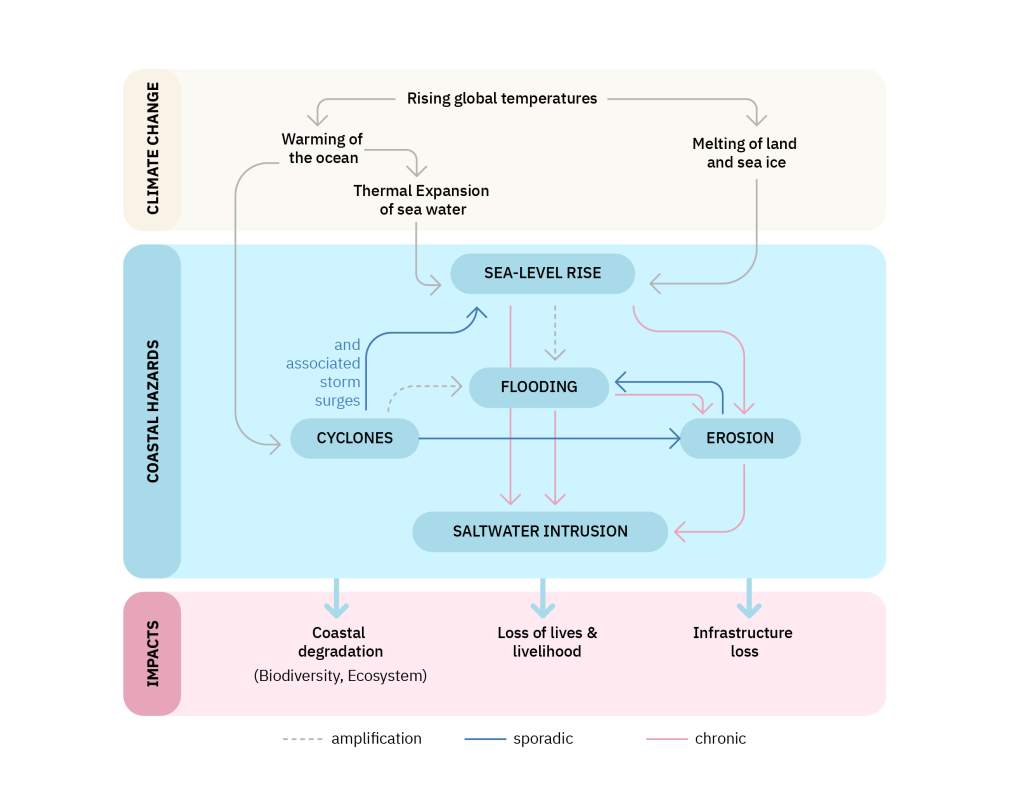
Recent studies indicate that India’s coastal regions are experiencing accelerating trends in climate-related hazards. Observed changes include relative SLR along both the east and west coasts, increasing frequency and intensity of cyclones in the Bay of Bengal and the Arabian Sea, more frequent coastal flooding and erosion, and growing saltwater intrusion into coastal aquifers and agricultural lands. These climate-driven hazards, together with non-climatic pressures such as coastal development, population growth, subsidence, and shoreline modification, are collectively transforming India’s coastal regions into high-risk zones and exacerbating existing social and ecological vulnerabilities.
Managing the complex risks emerging from these hazards depends critically on how coastal governance is structured. Over the past decade, India has taken important steps to assess climate vulnerability and develop adaptation measures for coastal regions through initiatives such as the National Coastal Mission (NCM) under the National Action Plan on Climate Change (NAPCC), and vulnerability assessments supported by the National Centre for Coastal Research (MoEFCC 2023). However, vulnerability assessments and adaptation planning remain focused on single hazards and are often implemented in silos. This fragmented approach overlooks the cascading and compounding nature of coastal hazards and limits the effectiveness of risk mitigation.
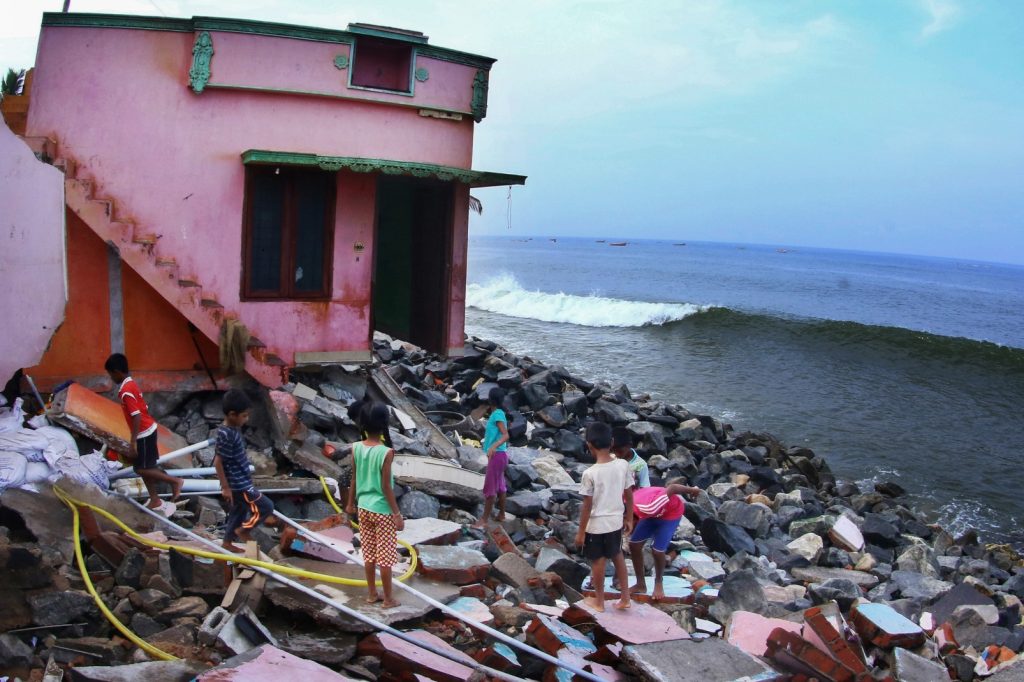
A significant body of literature shows that interactions between acute coastal hazards, such as cyclones and storm surges, and chronic coastal hazards, such as SLR, amplify impacts across social and ecological systems. Hence, continued reliance on single-hazard planning can result in blind spots and maladaptation.
In this issue brief, we highlight why strengthening coastal resilience in India requires moving beyond single-hazard planning and adopting an integrated understanding of interacting coastal hazards. We do this in 3 parts:
– First, by outlining key coastal hazards, their interactions, and emerging trends.
– Second, by examining India’s coastal governance landscape and its limitations;
– and finally, by proposing a shift toward a multi-hazard, systems-based approach to strengthen long-term resilience.