Gabriela Iacobuta, Navroz K Dubash, Prabhat Upadhyaya, Mekdelawit Deribe and Niklas Höhne

National climate change mitigation legislation, strategy and targets: a global update
Summary
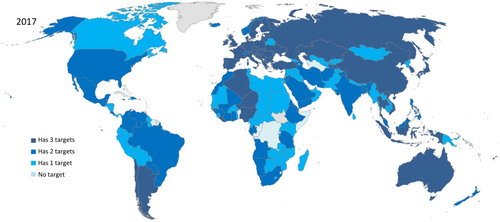
Global climate change governance has changed substantially in the last decade, with a shift in focus from negotiating globally agreed greenhouse gas (GHG) reduction targets to nationally determined contributions, as enshrined in the 2015 Paris Agreement. This paper analyses trends in adoption of national climate legislation and strategies, GHG targets, and renewable and energy efficiency targets in almost all UNFCCC Parties, focusing on the period from 2007 to 2017. The uniqueness and added value of this paper reside in its broad sweep of countries, the more than decade-long coverage and the use of objective metrics rather than normative judgements. Key results show that national climate legislation and strategies witnessed a strong increase in the first half of the assessed decade, likely due to the political lead up to the Copenhagen Climate Conference in 2009, but have somewhat stagnated in recent years, currently covering 70% of global GHG emissions (almost 50% of countries). In comparison, the coverage of GHG targets increased considerably in the run up to adoption of the Paris Agreement and 89% of global GHG emissions are currently covered by such targets. Renewable energy targets saw a steady spread, with 79% of the global GHG emissions covered in 2017 compared to 45% in 2007, with a steep increase in developing countries.
 Download the Study

Related Publications

Reports
Climate Policy
How Can India Align Its Clean Energy Innovations with Its Ambitions? An Assessment of Public RD&D Investments and Activities
Kashmeera Patel, Easwaran J Narassimhan, and Aman Srivastava
15 October 2026
This report examines India’s public clean energy RD&D investments across six key technologies to assess whether public cleantech RD&D innovations align with its broader clean energy, industrial, and climate ambitions.

Climate Policy
Climate Litigation and Democratic Governance in India
Shibani Ghosh
International IDEA | 5 October 2026
Climate litigation is emerging as an important avenue for addressing environmental harms and strengthening accountability in India. As climate-related challenges intensify, courts are increasingly being called upon to consider how constitutional rights, environmental protection, and democratic governance intersect. This case study examines the evolving climate litigation landscape in India and explores its implications for public participation, access to justice, and government accountability. It is part of a series on climate litigation and democracy in Asia and the Pacific, which examines how legal action is shaping participation, accountability, and rights-based responses to climate change.

Issue Briefs
Climate Policy
India’s Electric Vehicle Ecosystem: Stuttering Transition or Strategic Reorientation?
Arunesh Karkun, Kashmeera Patel, Aman Srivastava, and Easwaran J Narassimhan
11 August 2026
An analysis of the evolution of India’s EV policy landscape, the current state of domestic manufacturing, and the strengths and limitations of its RD&D ecosystem.