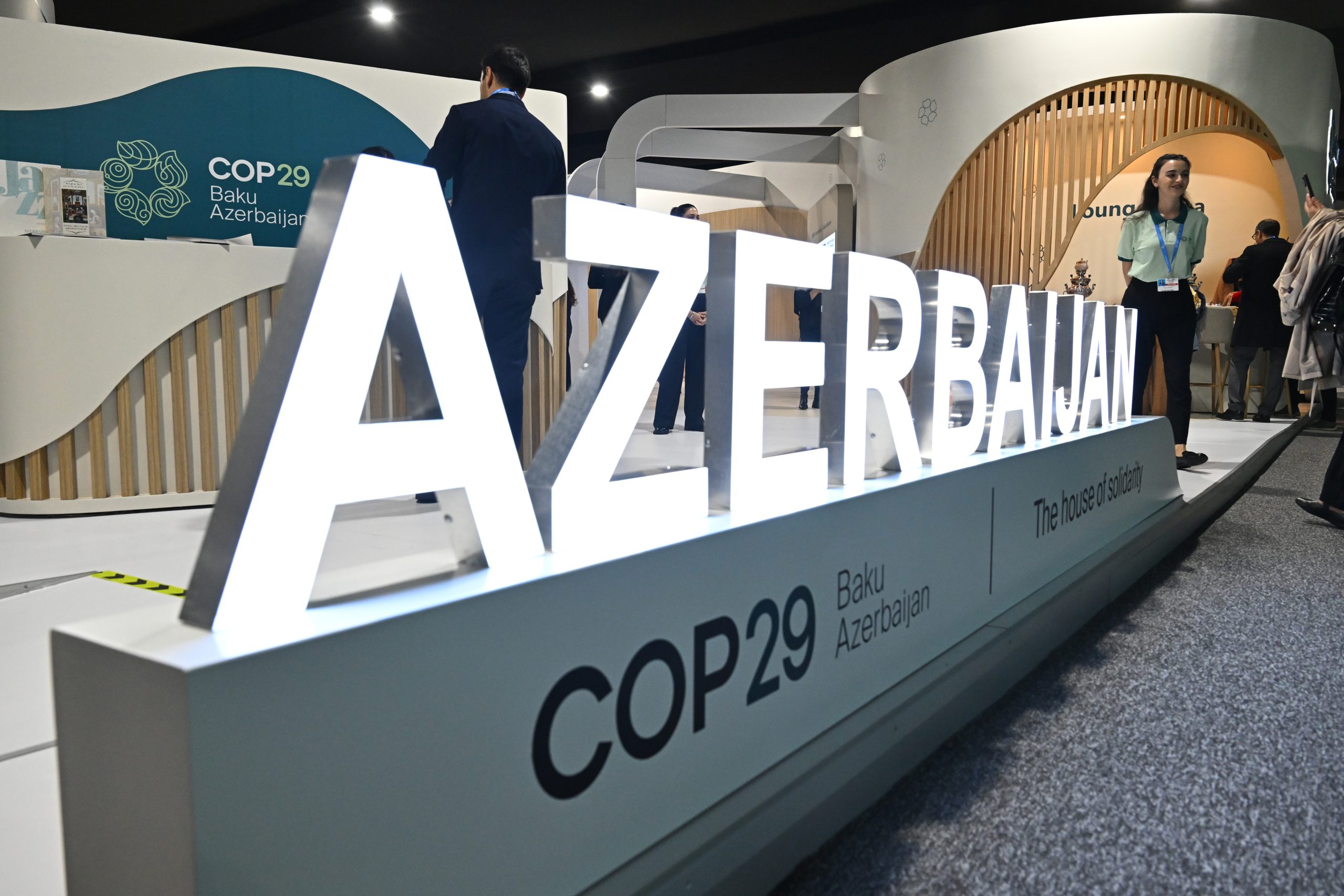
The much-anticipated New Collective Quantified Goal (NCQG) for climate finance took centre stage at COP29, the outcome of a three-year process to determine an update to the $100 billion that developed countries had committed to provide annually by 2020 in 2009. The final text set a goal of at least $300 billion per year by 2035, with developed countries taking the lead, from a wide array of public and private sources, and encouraging voluntary contributions from developing countries. This $300 billion goal is part of a broader stated ambition to scale up climate finance to $1.3 trillion per year by 2035 from all sources.
The outcome has drawn sharp criticism from developing countries – including India – which see it as insufficient to meet their climate finance needs and as shifting responsibility away from developed countries. Civil society groups and experts have widely echoed these sentiments, relying on the overused “COP-out” label.
Amid all the widespread criticism, this blog examines where the NCQG outcome falls short, explores whether developed countries have a defence, and looks ahead to how future COPs – and India specifically – can work to enhance climate finance and accountability.
Why the NCQG outcome is disappointing for developing countries
Developing countries have unanimously expressed disappointment with the NCQG outcome for three principal reasons.
It doesn’t take needs into account at all: The UNFCCC’s Standing Committee on Finance notes that the costed needs alone of just 98 developing countries amount to about $5.0–6.8 trillion by 2030, or on average $455–584 billion annually. Broader estimates indicate needs of about $1 trillion annually by 2030. In this context, the pledge of $300 billion – set as it is five years beyond these estimates – falls significantly short of the scale of support required for adequate climate action.
It also reflects a lack of ambition by developed countries when considering that finance flows will have to increase annually only by 7.6% between 2022 and 2035 to reach this amount, whereas they had increased by 9.2% per year between 2013 and 2022. Further, adjusting for global inflation between 2009 and 2024, the real increase of the quantum is only 1.86 times the $100 billion annual target for 2020.
With this, the urgent need for rapidly and comprehensively scaling up funding clearly remains unmet.
It offers no clarity on – or accountability from – funding sources: The phrasing of the broader goal in the decision text weakens accountability and leaves significant room for interpretation. For instance, it “Calls on all actors…to enable the scaling up of financing… from all public and private sources to at least USD 1.3 trillion per year.”
This framing is comparatively less stringent in tone, limits the expectations from concessional public finance (thereby risking over-reliance on private finance, which is often unaligned with developing countries’ priorities), and does not assign specific responsibilities to any particular groups, such as developed countries or MDBs. Even for the more concrete $300 billion target, developed countries are only tasked with “taking the lead,” while the text simultaneously encourages developing countries to “to make contributions…on a voluntary basis1,” which would appear to go against the developed country obligations outlined in Article 9 of the Paris Agreement. Lastly, there appears to be a voluntary agreement that the “alternative sources” that will count towards these goals will include all MDB climate finance to developing countries, rather than just the portion attributable to developed countries.
Put this way, the decision text presents a clear risk of shifting responsibility away from developed countries, undermining the principle of equity enshrined in the UNFCCC and the Paris Agreement.
It does not sufficiently prioritise adaptation: While the NCQG aims to balance the allocation of finance between mitigation and adaptation, it offers no clarity on how to achieve this balance. Least Developed Countries (LDCs) and Small Island Developing States (SIDS), already grappling with disproportionate climate impacts, are left with vague assurances rather than actionable pathways towards meeting their real and immediate adaptation needs. Some developing countries have also expressed unhappiness with the exclusion of loss and damage (L&D) as a category from the intended allocations of this quantum.
On these grounds – an inadequate quantum, limited accountability, and poor reflection of their priorities – developing countries have credible reasons to voice discontent. When we consider that developed countries only proposed a first concrete quantum on the penultimate day of negotiations, this does seem like a bad faith exercise that has once again kicked real action further down the road.
Do developed countries have a valid counterpoint?
A few factors – typically put forth by developed countries – may have contributed to limiting the NCQG quantum and determining its framing.
Developed countries are dealing with new and old pressures: Advanced economies are grappling with slowing growth, projected at 1.8% in 2025, well below the 2000–2019 average of 3.8%, which is exacerbated by rising inflation, declining investments, a shrinking labour force and ageing populations, and elevated debt levels2. Additionally, growing concerns about the socioeconomic consequences of climate policies have led to pushback from domestic interest groups, particularly in fossil fuel-dependent regions.
National security considerations may have also diverted resources from climate action. For instance, the Russia-Ukraine war has led to ramped-up funding for short-term energy security, reducing the focus on climate goals. Developed countries have also faced fiscal constraints due to Brexit, the Covid-19 pandemic, and illegal immigration, among other challenges.
These internal and external pressures mean that many developed countries may have – somewhat understandably – prioritised domestic challenges over international climate commitments. On the other hand, it is notable that 2023 U.S. federal spending alone was $6.3 trillion, while its international climate finance contributions were only $9.5 billion, less than 0.15% of this total. This illustrates that climate finance allocations remain extremely modest compared to these countries’ substantial spending abilities, with limited justification for their crowding out.
The US may exit the Paris Agreement: There is a clear likelihood of the United States, which is responsible for the largest share of historical emissions, of once again leaving the Paris Agreement under its incoming presidency. As a consequence, the European Union (EU) and other developed countries may end up having to shoulder a proportionately larger share of the climate action agenda. The possibility of US withdrawal will almost certainly have limited the quantum of the NCQG, and the EU’s ability to lead the delivery of even this modest quantum – as comparatively lower historical emitters and with their internal constraints – would be a laudable achievement that should go some way towards earning them global trust and credibility.
Present and future emissions trends cannot be ignored: Developed countries highlight the importance of also addressing present and future emissions. China is now by far the largest producer and consumer of coal, followed by India. Some experts note that the binary distinction between developed and developing countries is no longer helpful due to the diversity in incomes and emissions across countries, and that some large developing countries should also start becoming providers of climate finance. These calls are based on data that suggests that 42 percent of all greenhouse gas emissions since 1850 have been emitted in the last 30 years, and more than two-third of that has come from developing countries.
These arguments however sidestep the fact that the US is currently the largest oil producer the world has ever seen, that per capita emissions in developing countries continue to be very low, and that their large and rising absolute emissions reflect a continued failure of developed countries to provide meaningful climate finance thus far.
There is historical precedence to the framing of the NCQG: While the NCQG has been criticised for its loose framing, the Copenhagen Accord in which developed countries had committed to the 2020 $100 billion target had used very similar text: “…developed countries commit to a goal of mobilizing jointly $100 billion dollars a year by 2020…from a wide variety of sources, public and private, bilateral and multilateral, including alternative sources.” Similarly, paragraph 3 of Article 9 of the Paris Agreement states that “developed country Parties should continue to take the lead in mobilizing climate finance from a wide variety of sources…” By these yardsticks, the framing of the NCQG cannot be considered to be watered down, although equally, it also doesn’t increase accountability above the historical floors and risks including pre-existing and/or marginally climate-relevant finance within developed country contributions.
Similarly, developed countries argue that calls to include allocations for loss and damage within the NCQG quantum go beyond the Paris Agreement, the objectives of which are limited to mitigation, adaptation, and realigning finance towards consistency with these.
What does this all mean?
The NCQG outcome reflects the divide between developed and developing country perspectives on climate finance. Developing countries’ justifiable disappointment stems from the glaring gap between the quantum and actual needs, the lack of accountability from developed countries, and insufficient attention to adaptation and loss and damage. Developed countries – grappling with domestic constraints – emphasise the need for shared responsibilities that reflect future realities, even as their constraints fail to justify the inadequacy of the goal. The precedents in historical COP outcomes present a weak defence; the NCQG text reflects the framing of previous decisions but risks diluting the quality and concessionality of finance.
Climate negotiations are political processes, in which developed countries aim to limit their liabilities, while developing countries have an incentive to overstate their needs, reach agreement, and then voice dissatisfaction with outcomes. The extent to which the NCQG quantum falls short of the true additional amounts that are required remains to be seen. But it seems as though the open-endedness that was essential to securing consensus for previous decisions such as the Paris Agreement has also provided a ‘get out of jail free’ card to developed countries in the NCQG.
In this context, the NCQG represents a compromise, yet again, for developing countries. Perhaps a foreseeable one, seeing how developed countries had struggled to deliver even their $100 billion promise. But progress in future negotiations will now require greater understanding of each country’s domestic challenges, and working around them to revisit and ratchet both the quantum and the accountability. This will need to happen rapidly, to ensure that multilateralism retains its trust and effectiveness in meaningfully addressing climate change.
What does it mean for India? As a climate leader and a voice of the global South, India should continue to push for greater collective ambition and responsibility, particularly from developed nations, through successive COPs. At the same time, given the inadequacy of current multilateral progress, it is in India’s interests to increasingly rely on domestic (or minilateral) finance arrangements and thereby increase resilience to future COP failures. This will require strengthening and reorienting its financial system, using a careful mix of complementary policies and regulations, and aligning it more closely with industrial policy. It is critical to constructively and speedily navigate the path beyond this disappointing outcome. Our climate and economic futures might hang in the balance.
Endnotes
- Notably, some large developing countries have already been significant providers of climate finance, and this clause in the decision text may allow for this climate finance to be formally counted ↩︎
- The U.S. faces challenges including a projected current account deficit of 2.5% of GDP and high inflation. The EU struggles with low GDP growth (0.8% in 2024), declining inflation, and labor market weaknesses, particularly in Germany, the UK, and France ↩︎