This chapter, published in ‘India in a Warming World: Integrating Climate Change and Development’, Oxford University Press, sets the stage for a discussion on policies by reviewing the emergence of national policies and national institutions. This discussion starts with the National Action Plan on Climate Change (NAPCC) and its various Missions. It discusses how Indian climate policy was frequently dictated by the pursuit of ‘co-benefits’ that bring both climate and development gains, and the emergence of a multiple objectives framing as a useful guide for policy formulation. This leads to a discussion of the formulation of India’s NDC for the Paris Agreement. Significantly, the chapter also covers the spread of climate institutions, which while weak and in their early stages, provide the spaces within which climate discussion is likely to be mainstreamed, if at all, in coming years.
Read morePublication Type: Books and book chapters
India’s Evolving Climate Change Debate: From Diplomatic Insulation to Policy Integration
How is India engaging the climate change challenge? This introductory chapter in ‘India in a Warming World: Integrating Climate Change and Development’, Oxford University Press, explains the changing context for climate change debates in India, from one focused on diplomatic concerns of equity and responsibility for the problem, to one equally concerned with understanding its development implications. The chapter lays out the rationale for why the book examines climate change impacts, negotiations, politics, policies and integration across sectors, briefly discussing key themes. It ends with four overarching messages on the contours of the Indian climate debate.
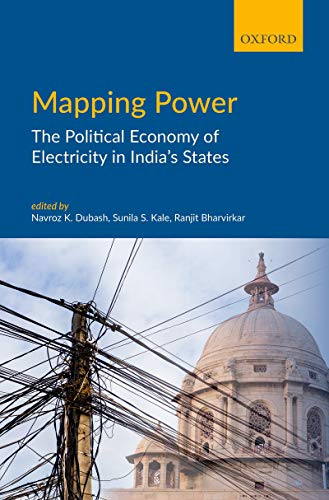
Read moreMapping Power: The Political Economy of Electricity in India’s States
Introduction
Despite several decades of reform, India’s electricity sector remains marked by the twin problems of financial indebtedness and inability to provide universal, high quality electricity for all. Although political obstacles to reform are frequently invoked in electricity policy debates, Mapping Power provides the first thorough analysis of the political economy of electricity in Indian states. Through narratives of the electricity sectors in fifteen major states, this book argues that a historically rooted political economy analysis provides the most useful means to understand the past and identify reforms for the future. The book begins with an analytic framework to understand how the political economy of power both shapes and is shaped by a given state’s larger political economy. The book concludes with a synthetic account of the political economy of electricity that is animated by insights from the state-level empirical materials. The volume shows that attempts to depoliticize the sector are misplaced. Instead, successful reform efforts should aim at a positive dynamic between electricity reform and electoral success.
Read moreProtecting Power: The Politics of Partial Reforms in Punjab
Summary
Punjab’s power sector, known for its agricultural embeddedness and chronic subsidy challenges, was one of the least attractive and pragmatic choices for reform advocates. Considering a feeble external push and forceful internal resistance, the state has undertaken partial electricity reforms to comply with legislative mandates from the central government. Despite limited reforms, Punjab has made substantive progress on electricity access, quality of supply, and some operational efficiencies. This chapter in ‘Mapping Power: The Political Economy of Electricity in India’s States’ analyses how the power sector has evolved in Punjab, especially through institutional restructuring and policy reforms, with the objective to examine the policy choices, outcomes, winners, and losers at the state level. It analyses the political–economic drivers for these policy choices and how they deviate from or comply with signals from the central government. Building on these findings, it also discusses the implications of past experiences and prevailing power dynamics for ongoing and future reforms.
Read morePoverty in the Midst of Abundance: Repressive Populism, Bureaucratization, and Supply-side Bias in Madhya Pradesh’s Power Sector
Summary
Electricity reforms in Madhya Pradesh remain underreported, despite some atypical outcomes. This chapter in ‘Mapping Power: The Political Economy of Electricity in India’s States’ examines the political economy of transitions in MP’s power sector, with the objective of identifying drivers of policy choices and their outcomes. Drawing on the findings, it explains how intensive institutional restructuring has resulted in bureaucratization and consolidated state control over the sector, and discusses the resulting outcomes. It also analyses the implications of past experiences for ongoing and future reforms.
Read moreTransforming Reforms: Hype, Hostility, and Placation in Andhra Pradesh’s Power Sector Reforms
Summary
Andhra Pradesh’s experience with electricity reforms and their political ramifications has not only been fascinating a case for political analysts, but also have influenced reform approaches in other states. This chapter in ‘Mapping Power (‘Mapping Power: The Political Economy of Electricity in India’s States’ explores the political economy of AP’s electricity sector transitions over four periods, with the objective to explain the drivers of policy choices and their outcomes. Drawing on the findings, it discusses the transformations in electricity reform strategy over two phases of reforms and analyses the implications of past experiences for ongoing reforms in the sector.
Read morePublic Participation in Indian Environmental Law
Summary
This chapter, published in the book Sharing the Costs and Benefits of Energy and Resource Activity: Legal Change and Impact on Communities (Oxford University Press), analyses the legislative and regulatory safeguards that protect and foster public participation in environmental governance in India. It considers the environmental rights jurisprudence that has been developed by the Indian courts and discusses it in the context of the three procedural rights that form part of Rio Principle 10.
In particular, the chapter examines the participatory processes under the Environment Impact Assessment (EIA) Notification, 2006 and the Forest Rights Act, 2006. It describes the opportunities provided for public engagement in the two laws and evaluates whether the participatory processes are indeed effective and whether public concerns can influence regulatory outcomes. The chapter concludes that while Indian law and judicial practice supports procedural rights in relation to environmental decision making, in practice, these rights are not just poorly implemented but also in danger of significant erosion.
Read moreClimate Change through the Lens of Energy Transformation
This chapter, published in ‘New Earth Politics: Essays from the Anthropocene’, explores existing conversations around energy transformation for a New Earth and puts forward ideas toward a conversation that might bridge the divide between how energy is supplied (how we produce) versus those who emphasize the demand side (how we use). The author approaches the problem by looking at four overarching narrative frames around energy and the implications of each for how energy is institutionalized and how it might be transformed. The four narrative frames explored are are climate change, energy security, energy poverty, and local environmental pollution.
Read moreMultilateral Diplomacy on Climate Change
This article in ‘The Oxford Handbook of Foreign Policy in India’ reviews India’s foreign policy on climate change, arguing that while it is marked by tactical virtuosity, it increasingly exhibits strategic vacuity. The chapter traces the evolution of India’s role in international climate negotiations, noting particularly India’s key role in highlighting equity and enshrining the concept of ‘common but differentiated responsibilities and respective capabilities’ as a cornerstone of the negotiation process. The chapter then examines the turbulent phase from 2007 onwards, when India, along with other large developing country allies, experimented with new articulations of climate policy. This discussion explores the emergent drivers of Indian climate policy, including international pressures, shifting domestic political context, the emergence of ‘co-benefits’ as a framing concept, and the role of key personalities. The chapter concludes by suggesting that an exclusive emphasis on an equitable climate deal should transition to an approach that provides equal attention to equity and effectiveness in international climate outcomes.
Read moreThe Rise of the Regulatory State of the South: Infrastructure and Development in Emerging Economies
Summary
Understanding the regulatory state of the south, and particularly forms of accommodation to political pressures, could stimulate a broader conversation around the role of the regulatory state in both north and south.This volume seeks to provoke such a discussion by empirically exploring the emergence of regulatory agencies of a range of developing countries across Asia, Africa, and Latin America. The cases focus on telecommunications, electricity, and water: sectors that have often been at the frontlines of this transition. The central question for the volume is: Are there distinctive features of the regulatory state of the South, shaped by the political-economic context of the global south in the last two decades? To assist in exploring this question, the volume includes brief commentaries on the case studies from a range of disciplines: development economics, law and regulation, development sociology, and comparative politics. Collectively, the volume seeks to shape the contours of a productive inter-disciplinary conversation on the emergence of a significant empirical phenomenon – the rise of regulatory agencies in the developing world – with implications both for the study of regulation and the study of development.
Read more